
Everyone expects me to exhibit what’s known as Canadian raising, where those of us from Southern Ontario say the word as if it were spelled “aboot”. People have a good chuckle, and I grumpily insist we don’t do that in Toronto, and then we go on our merry ways. It’s not really all that important, but it does make me think, sometimes, about the assumption that English words are meant to be read one and one way only. Perhaps “about” should sound like “aboot”; and “caught” and “cot” should be distinct from one another; and “think” and “fink” really ought to be homonyms. What about going the other way, from writing into speech? If I write “about”, how do you know I didn’t mean for it to be pronounced “aboot”? For London to be heard as Lundon? Or that “breed!” is actually an instruction for you to breathe? In truth, our assumptions about these choices say more about our own backgrounds and prejudices than we care to reveal. The same can be said about many other linguistic communities, both historic and current, around the globe. In the Turkic collections, a particularly interesting example of this phenomenon appears in our holdings of Azerbaijani manuscripts.
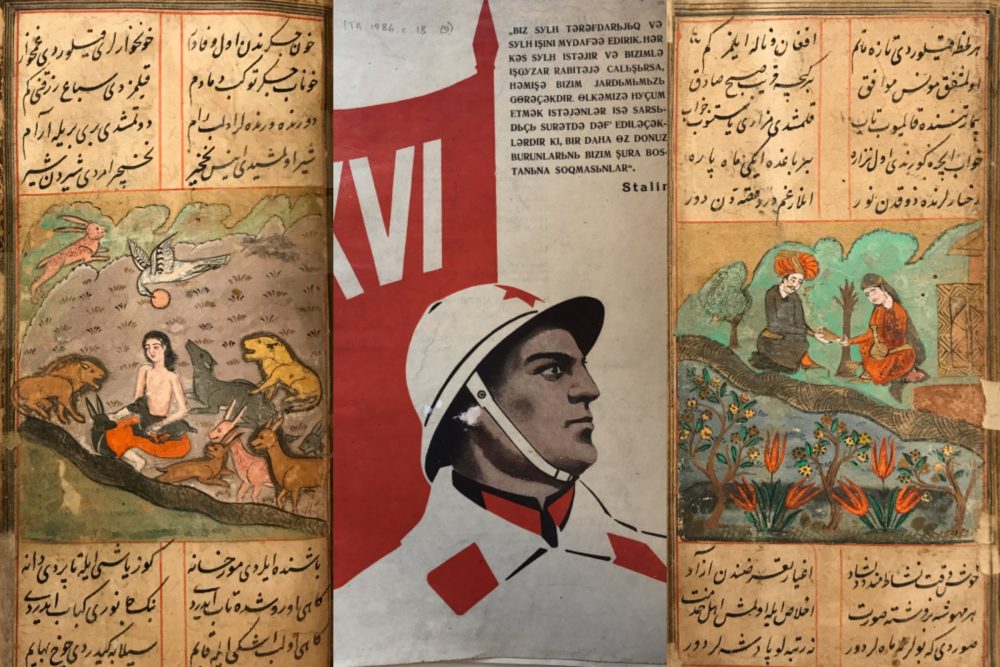
An illustration of a dream sequence featuring two individuals seated in a garden from a 16th-century recension of the story of Layla and Majnun in the Azerbaijani language. (Füzulî, Leyli vǝ Mǝcnun, Azerbaijan, 16th century CE. Or 405, f 97r)
It wouldn’t be one of my blogs if it didn’t start off with some sort of caveat. So, let’s get it out of the way. I use the term “ Azerbaijani” broadly in line with Euro-Atlantic linguistics: to denote a Turkic language of the Oghuz sub-branch that is closely related to Istanbul Turkish , and that is spoken in the Caucasus (especially the Republic of Azerbaijan) and in northwestern Iran. In English, we also have recourse to the shortcut Azeri, which usually means the Turkic language Azerbaijani. But Azeri might also mean Old Azeri or Azari, a now-dormant Western Iranian language from the same region that might be linked genetically to Tati or Talysh. In the Republic of Azerbaijan, the official name of the language is Azərbaycan dili (“Azerbaijan language”), but it can also be called Azərbaycanca (making use of the -ca/cə language suffix), or, less frequently, Azəricə. In this region, Azerbaijani was largely written in the Arabic script until the early 20th century, when the Soviet authorities first imposed the Latin-based Uniform alphabet in the late 1920s, and then a modified Cyrillic alphabet in the 1930s. In 1991, the year in which complete independence was achieved, the Republic of Azerbaijan officially adopted the Latin script for the language.
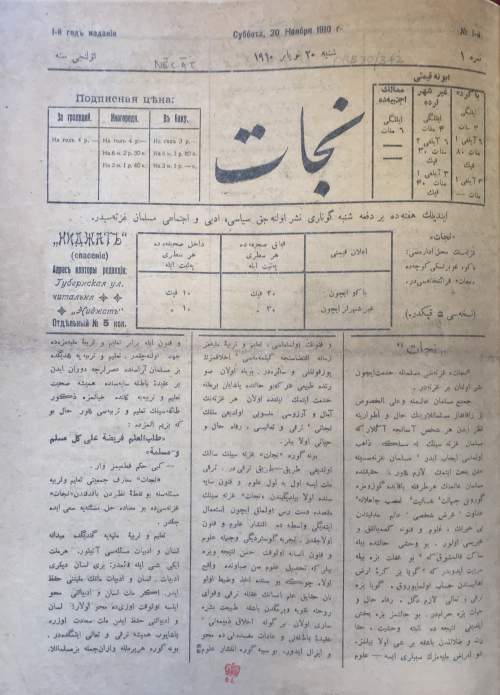
The first page of the newspaper Nicat (Salvation), published in Azerbaijani in Arabic script during the Tsarist period. (Nicat, 1:1 (Baku: Nicat Qiraatxanǝsi, 20 November 1910). ORB.30/342)
South of the border, in Iran, the term “Azeri” usually refers to the old Iranian language and not the Turkic one. Here, the preferred terminology is Torki (ترکی, in Persian) or Türkçǝ (تۆرکجه, in Azerbaijani), and the dominant script is a modified Arabic one. While the varieties spoken in the Caucasus and Iran are distinct dialects, they do form a single linguistic grouping, relying on many common grammatical and lexical features, and share a common linguistic history. Speakers of the language in Iran vastly outnumber those in the Caucasus (perhaps 13 million to just over 9 million in the Republic, according to the CIA World Factbook as quoted on Wikipedia). Azerbaijani is not an official language in Iran, but can be found fairly frequently online and in printed media. Turkic-speakers have long been integrated into broader Iranian society, and many notable personalities in Iranian history come from Turkic backgrounds: Shah Ismail I; Ahmad Kasravi; and yes, even the world-renowned singer, Queen of contemporary Persian pop, Googoosh.
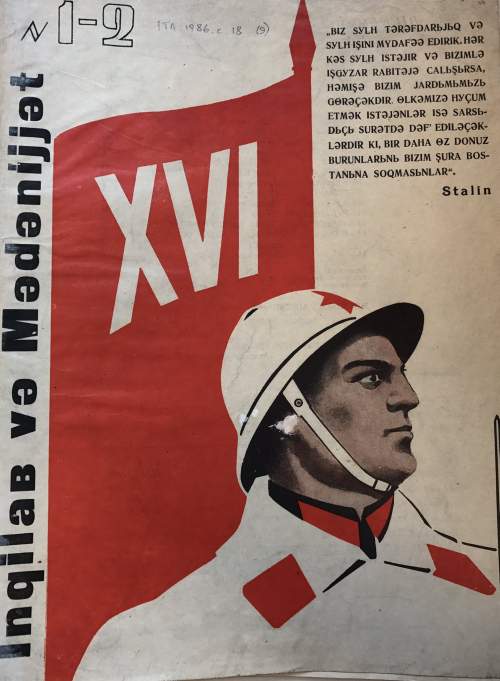
The cover of a periodical produced in Baku, Azerbaijan in the 1930s featuring the Latin alphabet imposed by Soviet authorities between 1927 and the late 1930s. (InqilaB vǝ Mǝdǝnijjǝt, 1-2 (Baku: AzǝriNǝshr, 1934). ITA.1986.c.18(9))
As always, there are considerable political implications to the choice of terminology. My intention here is to mirror common Anglophone usage of the terminology, not to promote a particular movement or point of view. That said, the question arises: what makes something an “Azerbaijani” manuscript? The British Library holds some 7 manuscripts that can be described as containing texts in Azerbaijani. All but one of these are in an Arabic orthography that mirrors Ottoman Turkish quite closely, leaving Arabic words in their original spellings and marking only some vowels in non-Arabic words. This might make it seem as though telling Ottoman and Azerbaijani apart would be impossible, but there are a few clues. One of the easiest is the use of a syllable final -x (like the ch in loch) where Ottoman Turkish would have a -k. Çok “many” or “very” in Turkish becomes çox in Azerbaijani, and bakmak “to look” in Turkish is baxmaq in Azerbaijani, for example. Turkish employs the suffix -iyor for the present continuous, while Azerbaijani uses -ir. And, after the 16th century, Turkish uses only the suffix -miş for the perfective, while Azerbaijani has both -miş and -ip (in the 2nd and 3rd persons). There are, of course, other tells in terms of phonology, morphology, syntax and lexicon, but these are usually the easiest. And they help clue us in, broadly speaking, to how to pronounce those undifferentiated spellings of Arabic words I mentioned up above.
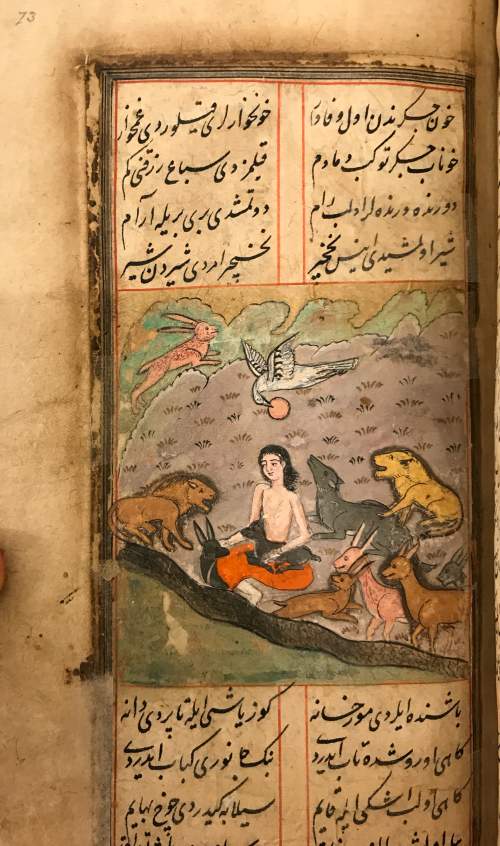
An illustration of Mǝcnun amongst animals from an illustrated 16th-century manuscript in the Azerbaijani language. (Füzulî, Leyli vǝ Mǝcnun, Azerbaijani, 16th century CE. Or 405, f 73r)
So what, exactly, do these manuscripts comprise? Usually literary works, but there are also a few historical items as well. Undoubtedly, the most awe-inspiring item is Or 405, Füzulî’s Leyli vǝ Mǝcnun, copied in 1075 AH (1664 CE). This is Füzulî’s own recension of the classical tale, and one that he admits to having translated from a Persian source on the behest of his friends in Istanbul. This bit of information is important, as it shows how Azerbaijani functioned as a literary medium independently of Ottoman (or Istanbul) Turkish, permitting the translation and adaptation of texts from other languages in its own right. The copy held by the Library is a spectacular specimen of the tale, as it is accompanied by vivid and bright illustrations that relate to the stories found within the text. There are some lovely examples of Leyli in a graveyard and Mecnun among animals, all of which combine a simplicity of line and feature with motion and bright colours. And Or 405 also contains more than a few examples of the linguistic features that help us distinguish dialects, whether the presence of çox and yox (written چوخ and یوخ ), or the preponderance of -ip forms throughout.
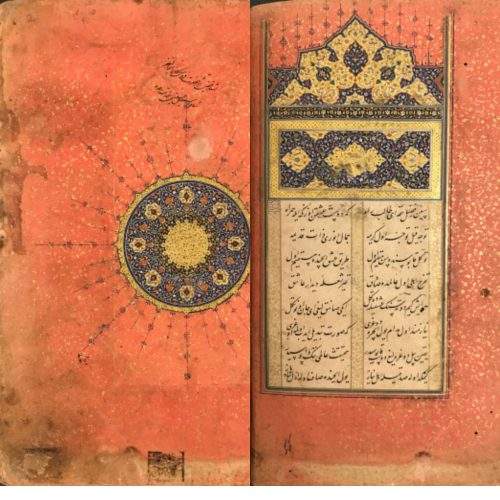
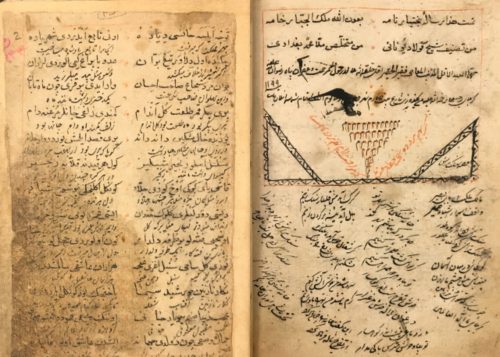
The şemse or sun motif (left) and opening text with unvan (right) of the Divan-i Xǝtai, exemplifying the lush illumination found throughout the volume. (Xǝtai, Divan-i Xǝtai, Iran or Azerbaijan, 16th century CE. Or 3380, ff 2r-v)
Or 405 is the only illustrated manuscript in Azerbaijani held at the British Library, but it is by no means the only beautifully constructed volume in the language. Or 3380, the Divan-i Xǝtai, is a 16th century copy of the collected poetry of Shah Ismail I, whose poetic pseudonym or mahlas was Xǝtai/Khaṭā’ī (خطائى). The work’s imperial connections are made apparent by the beautiful gold artistry and calligraphy employed throughout the volume. Shah Ismail was of mixed heritage and grew up speaking both Azerbaijani and Persian. Supported by various Turkic communities, he rose to power by defeating the Aq Qoyunlu confederation, and established the Safavid Empire, becoming Shah of Iran in 1501 CE. Ismail I is famous for many different reasons, including the imposition of Twelver Shi’ism as the official religion of his Empire, but he was also a renown poet in his own right. This confluence of political and literary prestige is undoubtedly the reason why his mahlas is written in gold throughout the work. Its entire construction is impressive; an example of luxury bookmaking in Safavid Iran. But so too is the poetry, which addresses both temporal and sacred love.