
Now Reading: A new philosophy of Baku’s foreign policy
-
01
A new philosophy of Baku’s foreign policy

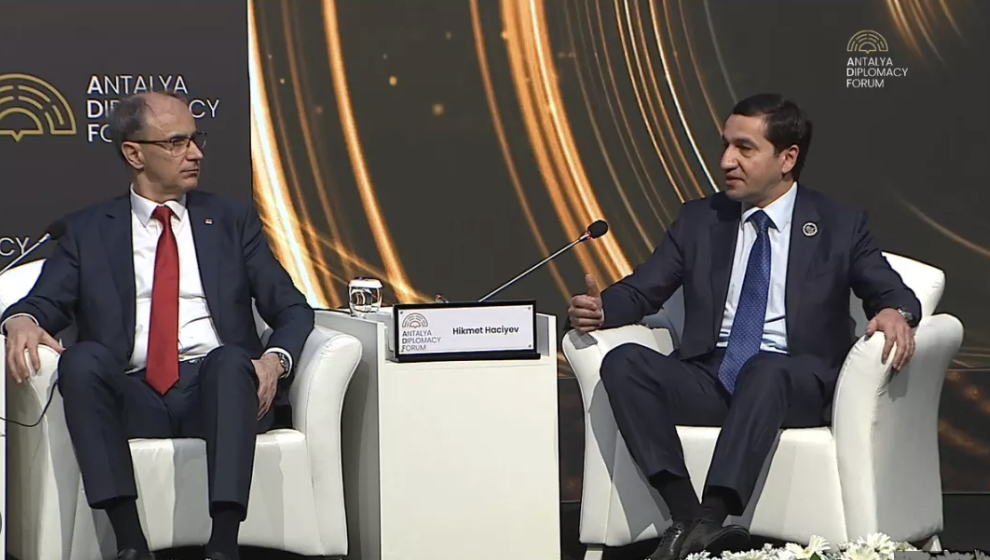
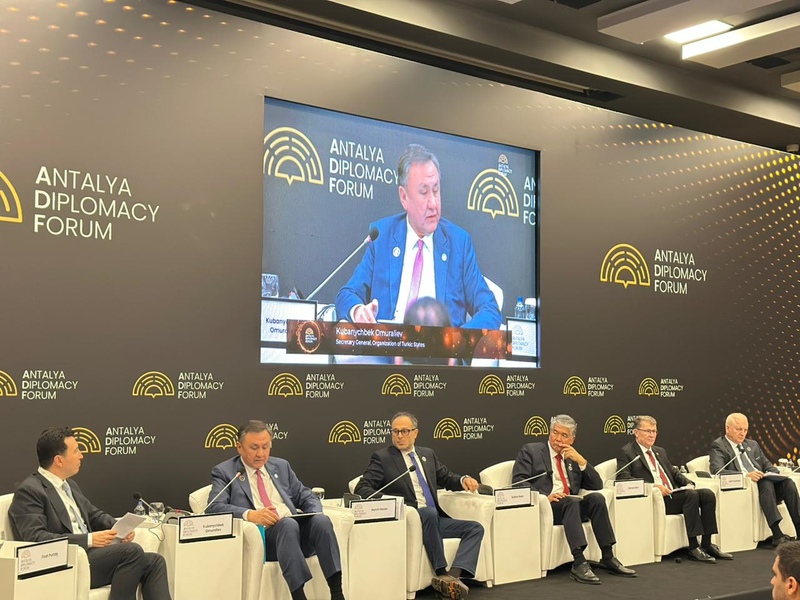
On April 16–18, a high-level Azerbaijani delegation led by President Ilham Aliyev took part in the 5th Antalya Diplomacy Forum, which in recent years has established itself as one of the key platforms for informal alignment on the most sensitive issues of the international agenda.
One of the most revealing moments highlighting the essence of Azerbaijan’s foreign policy at its current stage was the speech delivered by Hikmet Hajiyev, Assistant to the President of Azerbaijan and Head of the Foreign Policy Affairs Department of the Presidential Administration.
Building on ongoing global developments, which Hajiyev described as a “global security deficit,” he outlined Baku’s shift toward a model of regional agency as an alternative to ineffective external regulatory mechanisms. Drawing direct analogies—particularly through criticism of the OSCE Minsk Group, which throughout the long-standing Armenian-Azerbaijani conflict largely focused on accommodating the interests of external actors in the South Caucasus—he advanced the argument that prolonged external mediation not only fails to resolve conflicts but often freezes them. Sustainable outcomes, by contrast, are achieved when regional states themselves assume responsibility for the processes at hand.
Within this framework, regional agency is defined as a combination of three interconnected elements: responsibility, leadership, and integration. Responsibility entails abandoning the expectation of externally imposed solutions; leadership implies the readiness to shape the agenda; and integration involves building sustainable formats of intra-regional cooperation. Hajiyev emphasized that this is not a theoretical construct but an emerging practice, already being implemented through the institutionalization of the strategic alliance with Türkiye and its expansion into a network of bilateral and multilateral formats, including configurations such as Türkiye–Azerbaijan–Georgia and Türkiye–Azerbaijan–Iran. These mechanisms are positioned as the foundations of an emerging alternative architecture of coordination and security.
The peace agenda with Armenia—encompassing both the official track and a second track of informal contacts among civil society representatives—forms part of this evolving security architecture. This is complemented by the emergence and gradual expansion of trade and economic ties between Baku and Yerevan, contributing to a new geo-economic reality in the region. For Baku, it is also important to project the bilateral Azerbaijani-Armenian dialogue onto the broader South Caucasus system of relations. This implies the formation of an inclusive South Caucasus, where prospects for cooperation among Georgia, Armenia, and Azerbaijan are increasingly tangible.
Geoeconomics plays a central role in consolidating this agency. Energy and transport projects such as Baku–Tbilisi–Ceyhan and Baku–Tbilisi–Kars demonstrate the region’s capacity to independently develop infrastructure of global significance. In Baku’s view, agency is not validated by declarations but by control over the flows of energy and goods that integrate the region into the global economy as an active participant.
The development of new transport routes serves as a key instrument for shaping the regional agenda. Integrated into the broader North–South and East–West corridor systems, these routes position the region as a critical link in global supply chains. Among such initiatives is the TRIPP project, described as a strategically important corridor connecting Central Asia, the South Caucasus, and Europe, and gaining particular relevance.
As is known, this project—integrated into the broader framework of the Zangezur transport corridor—involves Azerbaijan, Armenia, and the United States, and is conceived as an inclusive platform in which Armenia is regarded as a transit participant within the emerging architecture. At the same time, Azerbaijan situates the project within the broader “four seas” concept—encompassing the Caspian, Black, Mediterranean, and Adriatic seas—significantly expanding its geographic and geo-economic scope. Currently, several segments of the Zangezur corridor within Azerbaijan are nearing completion, while reconstruction of the Nakhchivan segment is expected to be finalized by the end of 2026, with work being carried out in coordination with the United States and European partners.
In a broader context, Azerbaijan’s foreign policy extends beyond the South Caucasus, embedding itself within a more complex system of regional interconnections. Azerbaijan positions itself simultaneously as part of the South Caucasus, the Turkic world, Central Asia, and the adjacent Middle East. This multidimensional approach enhances Baku’s strategic flexibility, allowing it to integrate into multiple macro-regional systems while minimizing dependence on any single one. At the same time, regional agency does not imply isolation or inward focus; on the contrary, it serves as a foundation for more balanced engagement with external centers of power.
Taken together, for Baku the South Caucasus emerges as a geopolitical space where the rules are shaped from within, and external actors may participate but do not define the agenda. This represents not only an attempt to describe Azerbaijan’s current foreign policy trajectory, but also to shape its international perception, reinforcing the country’s role as a key actor in the emerging regional system of relations.
Ilgar Velizade
Related Posts

Previous Post
Next Post
- Aliyev says Turkic world is emerging as a major center of influence

- Baku hosts Turkic World Week honouring landmark 1926 Turkological Congress

- EU envoy holds talks in Baku ahead of high-level engagement with South Caucasus
- Europe must not lose Azerbaijan: Oleksiy Goncharenko on the risks of confrontation between Baku and the Council of Europe

- A leader forged by patience and victory