
Now Reading: Having lost in geopolitics, Moscow looks for someone to blame
-
01
Having lost in geopolitics, Moscow looks for someone to blame

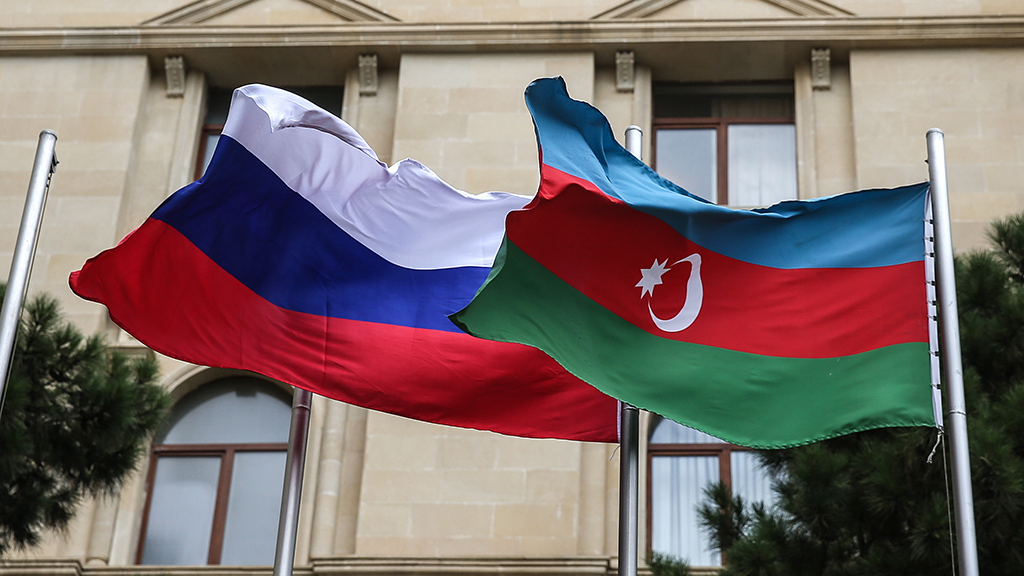
The Russian media cesspit Tsargrad, which is blocked in Azerbaijan, has produced yet another Telegram piece in its death throes, titled: “‘We Were Deceived’: Where Did Russia Miscalculate with Armenia?”
The author of the text, Doctor of Political Science and the first “head of the MGB of the DPR,” Andrey Pinchuk, is convinced that “since Armenia gained independence, its key problem has been Azerbaijan’s aggressive policy aimed at detaching Nagorno-Karabakh. Considering that Armenians did indeed show heroism in defending Karabakh and effectively won the war against Azerbaijan, the Nagorno-Karabakh Armenians became one of the dominant factors in regional politics. And the Nagorno-Karabakh clan became Russia’s key bet.” But “at some point Russia decided that the loss of Karabakh would weaken Pashinyan, and made this very wrong calculation. At the critical moment, when Azerbaijan launched the war for Nagorno-Karabakh, Moscow overestimated its influence over Baku.” He then concludes: “Who can now be offended at whom, and for what?”
Well then, let us sort this out. Honestly, and without the illusions so typical of Russian propaganda.
Since gaining independence, Armenia’s main problem was not “Azerbaijan’s aggressive policy,” but its own inability to build a normal state instead of pursuing territorial claims against its neighbors and aggression against Azerbaijan. As for the tales of the “heroism” of the Karabakh Armenians, those could also be toned down somewhat.
Armenia fought with Russia’s active support — one need only recall the 366th Motor Rifle Regiment. Territorial seizures followed a simple pattern: first, Russian “they-are-not-there” forces broke the resistance of Azerbaijani self-defense units, which, despite all their courage and self-sacrifice, had no chance of withstanding a regular army. Then the Armenian “lions with hearts of steel” calmly moved on to looting civilians and carrying out the ethnic cleansing of Azerbaijanis. For Moscow, the Nagorno-Karabakh clan became not merely a “bet,” but an instrument of control over the region — the classic imperial method of divide et impera, which in the 21st century looks not cynical, but pathetic.
The Second Karabakh War was also started by Armenia, not Azerbaijan. It is enough to recall how Armenia’s then defense minister, David Tonoyan, promised in November 2019, a year before the war, “a new war for new territories.” Armenia was counting on a repeat of the 1990s scenario. It did not work. On the frontline, it had to face a new Azerbaijani army — equipped with modern weapons, professional, and highly motivated. After losing both the war in the autumn of 2020 and the counter-terrorist operations in 2023, Pashinyan decided to take offense at Russia. Simply because Moscow did not live up to expectations.
Moreover, when an external patron turns your country into a bargaining chip, sooner or later there emerges a demand for sovereignty. Especially when Russia decides to push Armenia into defeat in a war in order to remove the inconvenient Pashinyan. At the beginning of his career, he was not at all the anti-Russian politician he is today. He sent Armenian sappers to join the Russian military mission in Syria and negotiated with Moscow over two additional military bases — in Zangezur and near the junction of the borders with Azerbaijan and Georgia. But after receiving such a “surprise” from the Kremlin, he took offense and decided to look for other allies.
Russia’s bet on Pashinyan’s downfall was not merely a miscalculation. It was a fundamental misunderstanding of the nature of modern societies. States that bet on tribal clans and the forceful retention of territories instead of institutions and legitimacy are doomed to historical defeat. Russia demonstrates this with frightening consistency.
Another of Pinchuk’s “settings”: apparently, when Azerbaijan began its operation to restore its territorial integrity, Moscow overestimated its influence over Baku. The Azerbaijani lobby supposedly played its role. And once again we hear the sacred phrase: “We were deceived.” Let us leave aside the ironic jabs: who exactly was counting on new Armenian territorial seizures, the occupation of Ganja, an advance to the Kura River, and so on? Simply put: who deceived whom? An empire accustomed to everyone around it being its vassals suddenly encountered the fact that middle powers no longer want to play by its rules. This is not betrayal. It is the natural disintegration of the sphere of influence of a dying empire.
One must not forget that the true victor is the Azerbaijani people and its soldiers, who liberated these lands with their blood.
And now to the main point.
Russia is in a state of systemic agony. For the fourth year, it has been unable to achieve a decisive result in a war against a country it intended to capture in three days. The Ukrainian army is conducting counteroffensive actions, while the Russian economy is cracking at the seams: fuel shortages, a budget full of holes, technological degradation, and a brain drain. Instead of admitting the failure of its governance model, Russian propaganda is looking for new enemies. Today, Azerbaijan has been chosen as the target.
And upon closer inspection, one cannot fail to notice that the ideological “superstructure” of today’s Russian state is based on imperial dreams and illusions dating, at best, from the middle of the 20th century. Having failed to win a real war, Russia furiously exploits the victory of 1945 — the only real achievement of the past eighty years. At the same time, it shamelessly appropriates all the glory for itself, although without Ukrainians, Belarusians, Kazakhs, and Azerbaijani oil, there would have been no “great victory.” Hitler understood perfectly well the strategic value of Baku. Without Azerbaijani oil, the Wehrmacht would have suffocated even earlier. Finally, the assistance of the Allies in the anti-Hitler coalition should not be underestimated either — from Lend-Lease to the Normandy landings and military operations in North Africa.
But Russia today, as always, has no time for historical truth. It needs a sacred victim and an eternal enemy. Having no future, it tries to live in the past. Having no achievements of its own, it parasitizes the achievements of its ancestors. Unable to build, it knows only how to destroy and sow chaos.
It tries to keep alive the conflicts that erupted back in the 1990s and provokes new ones. It tries to inflame passions in Syria, in Mali, and wherever else it can. And it sincerely believes that it is playing grand geopolitics. But this is not the policy of a great power. Today’s Russia is a state that has lost history.
Until Russia abandons its policy of putting spokes in the wheels of its neighbors, it will restore neither its image nor its ability to move forward. Until the “elder brother” complex disappears, it will have neither development nor pragmatic and respectful relations with its neighbors.
Nurani
Related Posts

Previous Post
Next Post
- Aliyev says Turkic world is emerging as a major center of influence

- Baku hosts Turkic World Week honouring landmark 1926 Turkological Congress

- EU envoy holds talks in Baku ahead of high-level engagement with South Caucasus

- Europe must not lose Azerbaijan: Oleksiy Goncharenko on the risks of confrontation between Baku and the Council of Europe

- A leader forged by patience and victory