
Now Reading: Ilham Aliyev in Karabakh: industry, infrastructure and security as priorities
-
01
Ilham Aliyev in Karabakh: industry, infrastructure and security as priorities

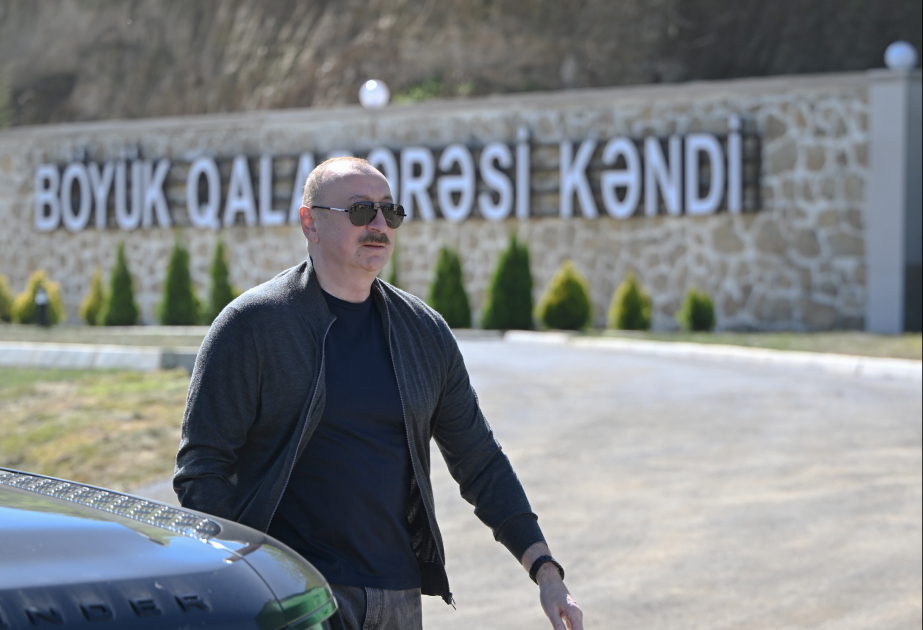
On May 28, Azerbaijan’s Independence Day, President Ilham Aliyev, following what has already become an established tradition, visited the liberated territories of the Karabakh Economic Region, where he took part in the opening of a number of infrastructure, cultural and industrial facilities.
The president began his trip in the Shusha district, where he reviewed the restoration of the village of Boyuk Galadarasi. Seventeen houses have already been restored there, and 14 families — 64 people — have returned to the village. Gas, electricity and water supply have been provided, internal village roads have been built, and public spaces are being created.
Boyuk Galadarasi is located south of Khankendi, not far from the new road built as an alternative to the former Lachin corridor. The return of residents to this area shows that the process of restoring Karabakh is gradually moving beyond major cities and covering rural areas around Shusha. Earlier, resettlement also began in Dashalti and Turshsu. In effect, a new network of settlements and economic infrastructure is gradually taking shape around Shusha.
Special attention should be paid to the traditional dialogue between the head of the Azerbaijani state and residents of villages in the liberated districts. This time, too, he remained true to that principle. At the same time, the main leitmotif of Ilham Aliyev’s address to the residents of Boyuk Galadarasi was the idea that, amid global turbulence, growing wars and conflicts whose outcomes no one can predict today, Azerbaijan has managed to achieve what even many major powers cannot: it has fully attained its objectives and closed a chapter that for decades remained a source of instability and war.
No less significant is the current stage — the restoration of the liberated territories, which has effectively become another indicator of the capacity of the Azerbaijani state. It is especially symbolic that all this is taking place precisely as the country marks another anniversary of its independence.
Azerbaijan has perhaps never been as strong in its modern history as it is today. Neither in 1918–1920 nor in the early 1990s was the state able to fully protect its borders and maintain control over all of its territories. The historical irony is that both more than a century ago and more than thirty years ago, Azerbaijan’s adversaries were essentially the same forces as today. The only difference is that today this adversary has been defeated.
That is why Baku today places special emphasis not only on military victory, but also on the restoration of Karabakh as a symbol of the fact that the state has been able to firmly consolidate the results of victory — politically, economically and demographically.
In this context, the subsequent part of the Azerbaijani president’s program in Karabakh appears particularly noteworthy. Visiting Khankendi, Ilham Aliyev took part in the opening of the reconstructed Cultural Center. The building, constructed back in the 1960s and 1970s, has been thoroughly renovated and now serves as a multifunctional facility with a cinema, a theater venue and a concert hall. The center is designed to host concerts, forums, festivals and other large-scale events.
Finally, in Khankendi, Ilham Aliyev inaugurated the GP Safety LLC enterprise for the production of work gloves, while in Khojaly he opened the Karabakh Textile House. Both enterprises are equipped with modern Chinese machinery and employ Chinese commissioning specialists, while the factory in Khojaly also uses Turkish equipment. The enterprise will produce bed linen, blankets, towels and other home textile products. Raw materials are expected to be supplied from Türkiye and Uzbekistan, while the finished products are intended both for the domestic market and for export.
At the same time, these are no longer isolated projects. It should be recalled that last year the Azerbaijani-Uzbek textile enterprise Businesstex JV was opened in Khankendi, while footwear, garment and other light-industry enterprises were launched in the Aghdam Industrial Park. In effect, a new textile and industrial cluster is gradually being formed in Karabakh. In many ways, this represents a return to the region’s historical specialization, as even during the Soviet period it was associated with cotton growing, sericulture and textile production. The difference is that this model is now being built under new economic conditions. Whereas Karabakh was previously integrated mainly into the intra-Soviet economic system, today the region is being incorporated into broader Eurasian production chains, strengthening the non-oil industrial potential of Azerbaijan’s economy.
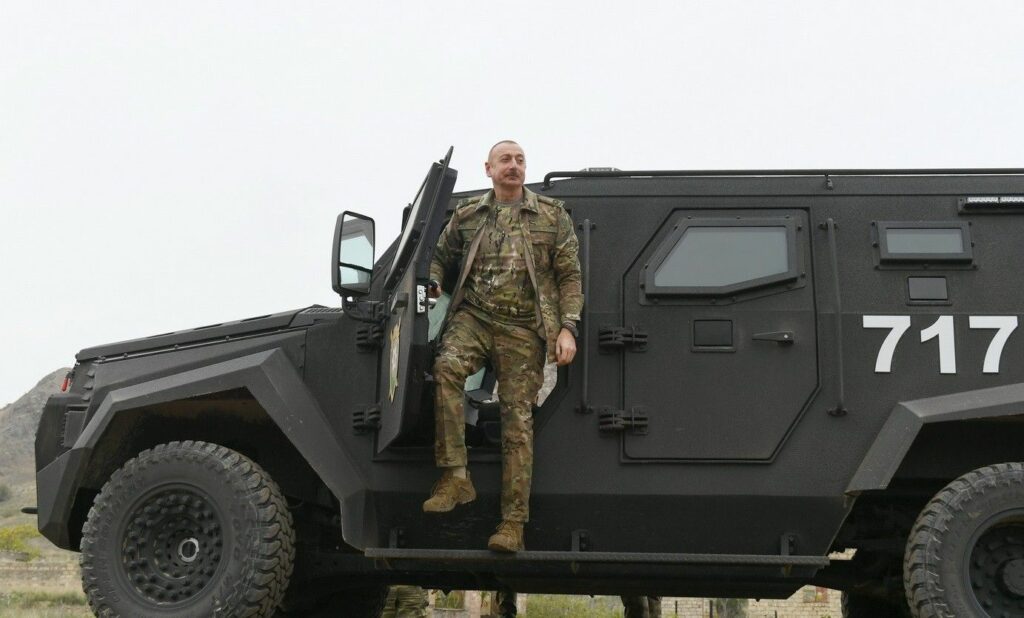
A separate part of the program was the review of housing for servicemen in Khojaly. This is no less indicative, since alongside civilian construction, modern military infrastructure is also being developed in the region.
For Baku, the security of Karabakh remains no less important than the region’s economic recovery, since the main priority is to ensure normal and safe living conditions for people returning to the liberated territories. That is why, alongside civilian infrastructure, a modern security system is also being formed here. Any attempts to test the region’s resilience again or to call the existing realities into question, whoever may undertake them, will be firmly suppressed.
Ilgar Velizade
Related Posts

Previous Post
Next Post
- Aliyev says Turkic world is emerging as a major center of influence
- Baku hosts Turkic World Week honouring landmark 1926 Turkological Congress

- EU envoy holds talks in Baku ahead of high-level engagement with South Caucasus
- Europe must not lose Azerbaijan: Oleksiy Goncharenko on the risks of confrontation between Baku and the Council of Europe
- A leader forged by patience and victory