
Now Reading: Azerbaijan positions itself as a new economic bridge for the Islamic world
-
01
Azerbaijan positions itself as a new economic bridge for the Islamic world

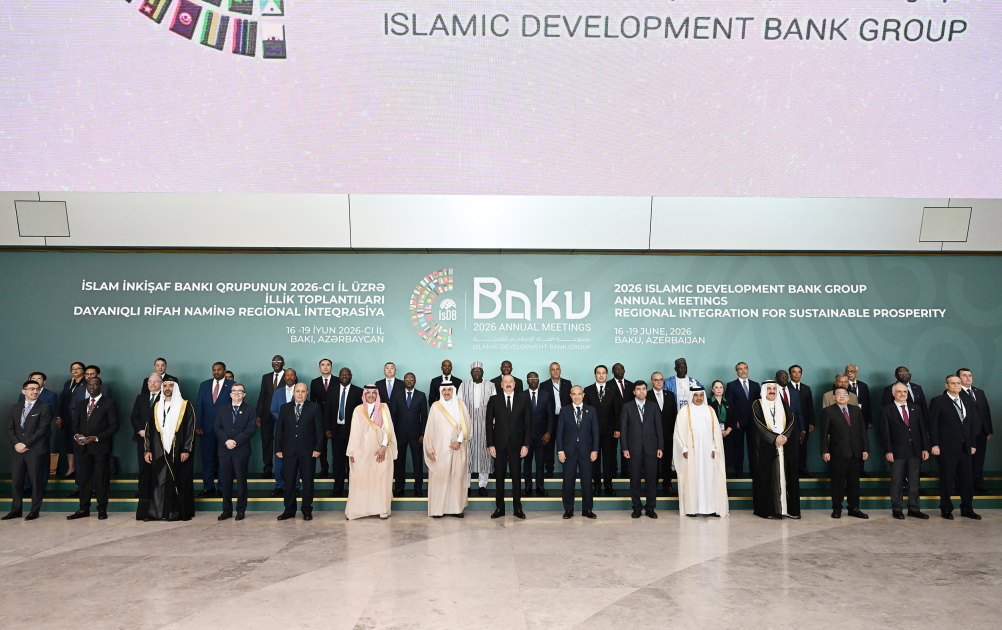
The Annual Meetings of the Islamic Development Bank Group in Baku became more than a major financial event. They also highlighted Azerbaijan’s changing role in the wider economic geography of the Islamic world.
This was the second time in the past fifteen years that Azerbaijan hosted the IsDB’s main annual gathering. But the context today is very different from 2010. Azerbaijan is no longer viewed only through the prism of oil and gas exports. It is increasingly presenting itself as a country where energy resources, transport routes, investment policy and regional stability come together.
President Ilham Aliyev’s address at the event reflected this broader transformation. One of the central messages was stability. At a time of wars in the Middle East, the conflict around Ukraine, growing US-China rivalry and instability in several neighbouring regions, Azerbaijan is trying to position itself as a predictable state capable of guaranteeing long-term infrastructure and investment projects.
For investors, this factor is becoming increasingly important. In the current global environment, stability is not just a political advantage. It is an economic asset.
Another important theme was Azerbaijan’s foreign policy balance. Baku continues to avoid rigid bloc politics and maintains working relations with different centres of power. For a landlocked country building its future around connectivity, this approach is essential. Azerbaijan’s economic strategy depends on cooperation with neighbouring states and access to wider regional markets.
The economic part of the president’s speech focused on diversification. Aliyev noted that more than 70% of Azerbaijan’s GDP is now generated by the non-oil and gas sector. At the same time, he acknowledged that exports remain heavily dependent on energy resources. This means that the next stage of development must focus on expanding non-oil exports, attracting investment and entering new markets.
Azerbaijan does not see diversification as a rejection of its traditional energy role. Instead, the goal is to build a more balanced economic model. Oil and gas will continue to provide major revenues, while also supporting the development of new sectors.
In this model, energy is expected to work together with logistics, industry, digital technologies and renewable energy. The purpose is not to replace existing export sectors overnight, but to reduce vulnerability to global energy price fluctuations by creating additional sources of growth.
Transport connectivity is another pillar of this strategy. President Aliyev again emphasized Azerbaijan’s ambition to become one of Eurasia’s key logistics hubs. The East-West and North-South corridors, together with the growing importance of the Middle Corridor, are now seen as long-term drivers of economic development.
This is particularly important for the Islamic world as well. Azerbaijan can serve as a bridge between Central Asia, the South Caucasus, the Middle East and Europe. Its ports, railways, roads and energy infrastructure give the country a role that goes beyond its own national market.
The reconstruction of the liberated territories was another major part of the message. Karabakh and Eastern Zangezur are now presented by Baku as one of the country’s largest investment projects. Billions of dollars have already been allocated from the state budget, and Azerbaijan is interested in attracting foreign investors to infrastructure, energy, agriculture, tourism and urban development projects in these regions.
The political meaning of this reconstruction is also clear. Azerbaijan sees the restoration of its territorial integrity as the end of one historical stage and the beginning of another — a stage focused on development, connectivity and reintegration.
The IsDB meetings in Baku therefore showed how Azerbaijan wants to define its place in the Islamic economy. It is not seeking to be only an energy supplier. It wants to be a stable investment destination, a transport hub, a financial partner and a platform connecting different regions.
After the end of the Karabakh conflict, Azerbaijan is moving toward a new development model based on energy strength, logistics, non-oil growth, financial stability and large-scale reconstruction.
This is the role Baku is now offering to international financial institutions and investors: a country at the intersection of regions, markets and corridors, with stability as its main strategic advantage.
Related Posts
Previous Post
Next Post
- Aliyev says Turkic world is emerging as a major center of influence
- Baku hosts Turkic World Week honouring landmark 1926 Turkological Congress
- EU envoy holds talks in Baku ahead of high-level engagement with South Caucasus
- Europe must not lose Azerbaijan: Oleksiy Goncharenko on the risks of confrontation between Baku and the Council of Europe
- A leader forged by patience and victory