Now Reading: A leader forged by patience and victory
-
01
A leader forged by patience and victory

History is usually written as a sequence of events, yet it is lived as a change in weather. Generations pass beneath the same sky without noticing that it has slowly darkened or cleared, that the plates beneath their cities have begun to move and that, sooner or later, they will collide. Most statesmen are born, rule and leave this world without ever hearing that subterranean rumble. They govern the weather of a clear day. Only a few are able to distinguish another sound — the one that comes from the depths of time — and understand that the age into which they were born is reaching its end, while another, breaking the familiar order of things, is already approaching.
History preserves such figures for moments of rupture. They do not choose their hour; the hour chooses them. Octavian was still a sickly young man when Caesar’s blood had not yet dried on the Roman Forum and the republic, which had stood for five centuries, was already cracking like an old suit of armour on an heir who had outgrown it. No one expected anything from him except an early death in the struggle of stronger men. Yet, patiently and almost imperceptibly, year after year, he gathered from the ruins of the republic something unprecedented — an empire destined to outlive its founder by fifteen centuries. Bismarck united Germany not with speeches and parliamentary resolutions, as naive orators imagined, but with iron and blood: he understood that the era of fragmented German principalities was over, and that in its place either a united Germany would emerge or foreign powers would divide the German lands among themselves.
What unites such men is not power; history has had more than enough of power. What unites them is a far rarer gift: the ability to stand on a tectonic fault line and not freeze, but act. To feel the movement of plates before it becomes an earthquake, and to build the house in such a way that it stands where others collapse. This article is about one such figure.
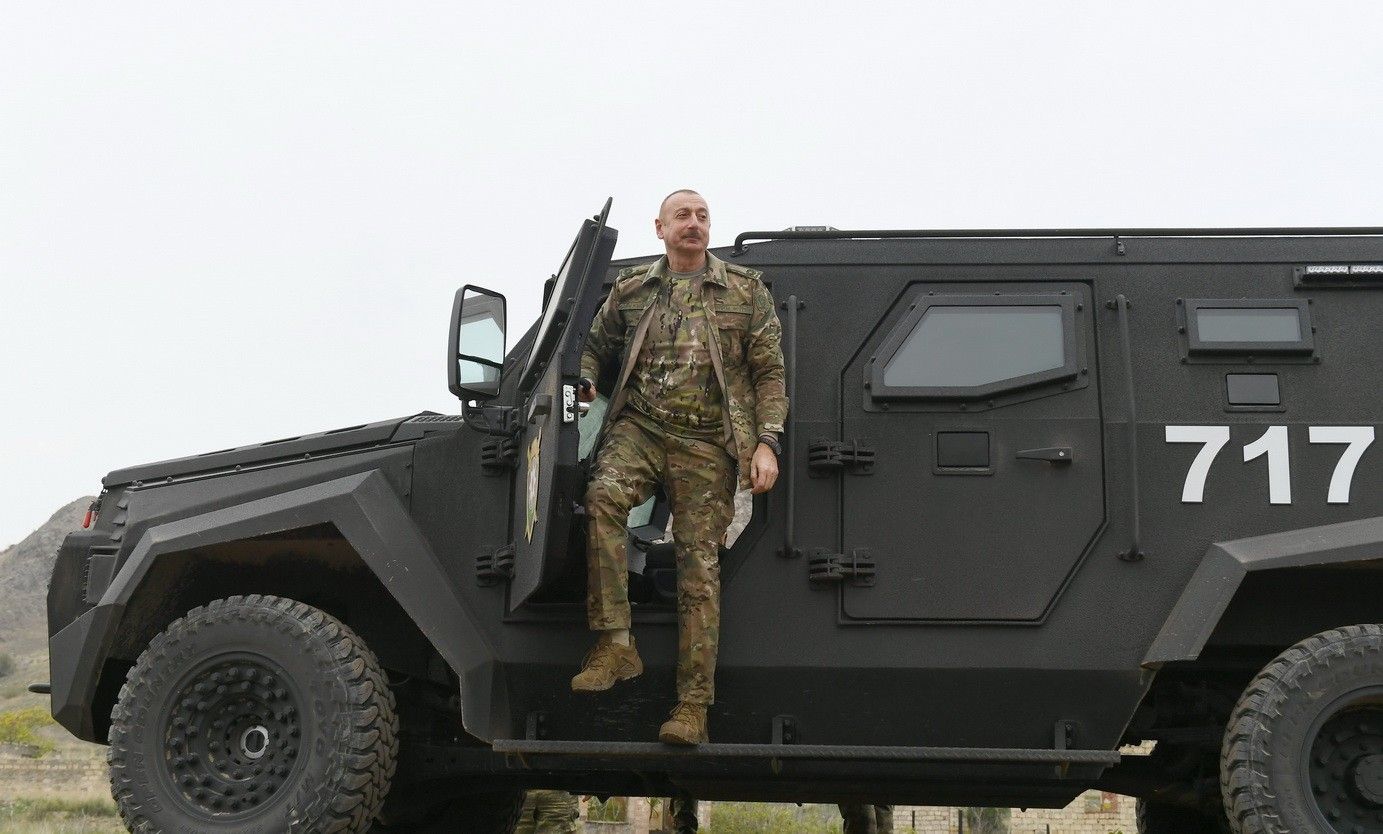
On June 26, Azerbaijan marks Armed Forces Day, and the date obliges us to speak not about parades, but about the essence of what is called an army — and about the man who commands it. An army is the highest embodiment of state will, the line where the design of a politician is paid for with the blood of a soldier. Therefore, every discussion of a Supreme Commander-in-Chief inevitably becomes a discussion of the price he is prepared to pay, and whether he spends the lives of his soldiers in vain or leads them to victory with firm calculation. There are commanders glorified by the deaths of their own soldiers, and there are leaders whose glory lies in preserving the army for victory rather than burning it for vanity. On this day, the nature of a statesman is best judged through the prism of how he used the courage of those who followed him and their country into death.
Every great figure carries the shadow of a predecessor, and for Ilham Aliyev that shadow was his father — the man who led Azerbaijan out of the chaos of the early 1990s and gave the state its backbone. To inherit something great is perhaps no easier than to create it. A successor is forgiven no weakness: every success is attributed to the foundation already laid, while every failure is charged to him alone. History knows entire dynasties in which the work of the founder ended with a son who could preserve what he received, but could not multiply it; and preservation without multiplication is only a slow form of dying.
In the early years, many watched Ilham Aliyev with precisely this hidden expectation of decline. In the West, he was habitually listed as a transitional figure, a temporary custodian of his father’s legacy. Inside the country, some assumed that the young leader would merely govern what had already been built, harvesting what he had not sown. Two decades passed, and it became clear that he had not squandered what he inherited, but invested it in an unprecedented cause and multiplied it many times over. The man many considered a keeper turned out to be a builder; the one in whom they saw only continuation became an independent magnitude. This is the first key to his nature: the ability to carry the burden of a great name without bending under it or hiding behind it, but turning it from a weight into a pillar.
Few have managed such a task. More often, legacy crushes. The son of Charlemagne, the pious and far from foolish Louis, inherited the greatest empire of the West and within a single generation allowed it to break apart into fragments from which Europe’s map would be pieced together for a thousand years. To hold what another has built and still build one’s own is a task before which even much louder names have failed. Aliyev solved that task, and he solved it in such a way that the world saw the result before it noticed the effort.
There is a widespread and deceptive belief that the strength of a statesman is measured by the loudness of his gestures. In truth, real strength is almost always quiet, and reveals itself in the ability to wait. The hardest thing is not to act when action is passionately desired, when everyone around shouts, hurries, accuses you of inaction, while you, with clenched teeth, hold the pause and know: the time has not yet come, and a premature strike will destroy what a patient strike will save.
For almost three decades, Karabakh remained an open wound. The seven surrounding districts lay in ruin; a million refugees and internally displaced persons wore out their lives in dormitories and camps; and the prosperous, indifferent world repeated its mantras about the inadmissibility of a military solution while, year after year, papers were moved from one office of mediators to another, where the conflict was preserved like a specimen in the formaldehyde of diplomacy. It would have been easy to break. It would have been easy to yield to the pressure of the street and throw an unprepared army against positions fortified for years — and drown in blood. But behind outward calm there was invisible work: weapons were forged, alliances were built, strength was accumulated, and the one turn in world circumstances was awaited when a strike would no longer be recklessness, but calculation.
Fabius knew how to wait in this way, the man whom his contemporaries mocked as Cunctator, the Delayer, because he avoided a decisive battle with Hannibal; yet he was not avoiding battle, he was wearing down the seemingly invincible Carthaginian until that invincibility melted away. Kutuzov knew how to wait in this way, surrendering Moscow in order not to surrender Russia, enduring for it the abuse of the salon rabble that understood war no better than a man understands chess when he sees only the current move. Patience of this kind is not timidity. It is the highest form of courage: the resolve to postpone triumph so that triumph may actually happen.
In the autumn of 2020, the hour struck. What had been accumulated for decades was released in 44 days. And the world, accustomed to seeing Azerbaijan as the defeated party, saw a state that took back what was its own — without mediators and without anyone’s mercy.
But behind the dry words of victory stands something that no official formula can express: the feat of the ordinary soldier. The design is born in the silence of an office, but it is carried out on sheer slopes, under fire, at the price of life itself. Those who climbed the heights of Murovdag, fortified for years, those who liberated Shusha — that unassailable city raised almost into the clouds — almost without heavy equipment, in close combat, over cliffs the enemy considered impassable, joined the ancient brotherhood of warriors who go toward certain death for something greater than themselves. So stood the three hundred Spartans at Thermopylae, shielding Hellas with their bodies; so went Finnish ski troops against the bunkers of the Karelian Isthmus in the Winter War. A height watered with blood is dearer than any height taken without loss; in it lies the measure of a people’s dignity. And when victory is spoken of as a triumph of command calculation, we remember that this calculation was paid for by those who remained on the slopes, and that the greatness of the Supreme Commander is measured not by the number of fallen, but by the fact that not one of their sacrifices was in vain.
This is the honour of the commander before the memory of the fallen. An incompetent general carpets the road to victory with the bodies of his soldiers and calls it victory; a wise one leads the army so that every life given becomes a step toward liberation, not a line in a mournful list of recklessness. Here again one recalls patience. The years of waiting were not diplomacy alone; they were the saving of those very lives that a premature, unprepared strike would have burned uselessly at the same heights. A commander who knows how to wait ultimately protects his soldier more than one who throws an unready army into the fire under the cries of an impatient crowd. And three years later, in September 2023, the final knot was untied in a single day. A thirty-year wound closed. Only then did it become clear that the calm once mistaken for weakness had been a drawn bowstring.
Geography is destiny, the ancients said, and for Azerbaijan the verdict of geography is severe. The country lies at a crossroads where the interests of powers accustomed to treating other people’s lands as bargaining chips converge. To the north is Russia, with its imperial memory and its habit of seeing the post-Soviet space as its backyard. To the south is Iran, an ancient civilization and restless neighbour, within whose borders lives a large Azerbaijani community. Nearby is Türkiye, brotherly, yet even brotherhood has its own logic, interests and calculations. And above all this is the distant but tenacious gaze of the West, ready to speak of values exactly up to the line where its own interests begin.
For a small state caught between such millstones, history usually offers an unenviable choice: bow to one in order to be saved from another. Dozens of countries have taken that road, and the bones of their independence lie bleached along the whole path of imperial politics. The temptation is great. Under a strong hand, life seems calmer; decisions can be shifted to a suzerain and one can live as a vassal. But a vassal does not control his own fate. Others control it for him, and when the hour comes that the suzerain finds him inconvenient, he is traded away without a tremor.
Aliyev chose something different and far more difficult: a position of equal distance, bowing to no one and speaking with all on equal terms. This requires the art of a tightrope walker, for to keep balance between Moscow, Tehran, Ankara and Washington — without turning anyone into a mortal enemy and without bending before anyone — is a task beyond the reach of entire diplomatic schools.
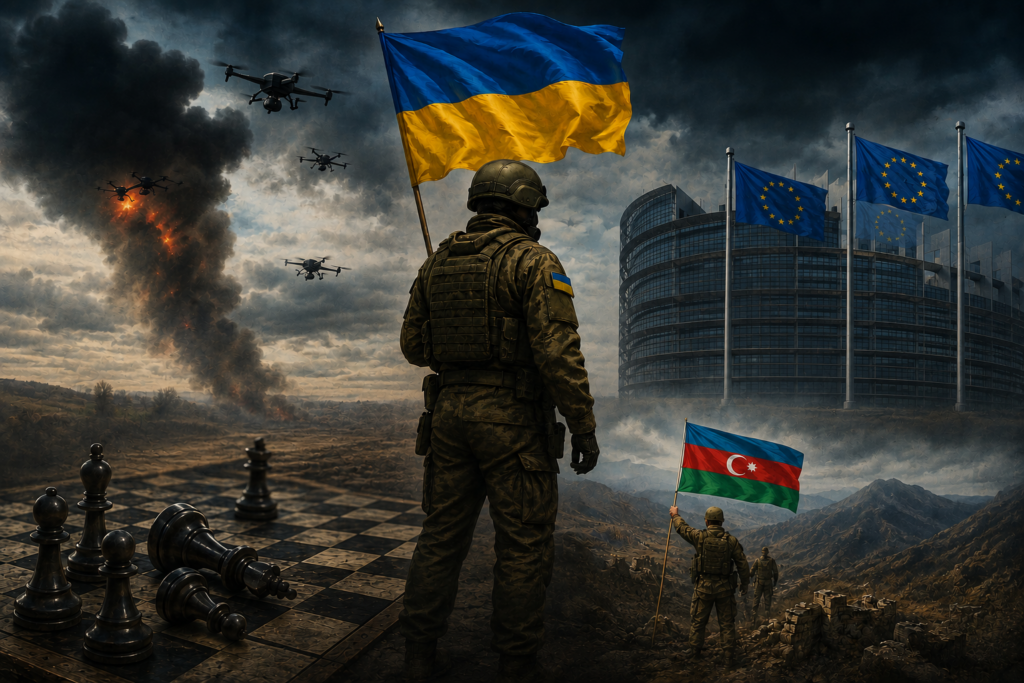
When the war in Ukraine erupted and split the world into camps, Azerbaijan, like everyone else, was expected to make a choice. Baku preserved steady relations with both Moscow and Kyiv, following its own line where others lost all independence by dissolving into other people’s coalitions. At the same time, it clearly marked the principle on which it never manoeuvred: the territorial integrity of states is a supreme and indivisible principle, the very principle in whose name Azerbaijan itself restored what was its own. This is the real form of sovereignty — not the paper independence written in charters, but the living, daily defended ability to decide one’s own destiny without asking anyone’s permission.
The most dangerous thing for a man is not defeat, but victory. Defeat humbles; victory intoxicates and whispers the temptation to go all the way, to finish off the fallen, to savour another’s humiliation. The victor begins to think that fortune has signed an eternal pact with him. Great men have broken on this temptation. Napoleon, who did not know how to stop in time, drove his star from triumph to triumph until it led him into the snows of Moscow and then to the rock of Saint Helena. Versailles, dictated by victors drunk on 1919, humiliated defeated Germany so deeply that from that humiliation, twenty years later, rose an even more terrible fire. History repeats the same lesson, and people do not hear it: excessive victory gives birth to excessive revenge.
All the more remarkable, then, is what happened after Karabakh. The victor, who had every reason to dictate and to triumph, chose not the language of a conqueror, but the language of a builder of peace. Instead of keeping the defeated neighbour forever under his heel, he extended a hand — offering an agreement, a shared future in a region that for decades had known only hostility. This is not the conduct of power intoxicated with itself, but of power that sees clearly and understands that only a peace which does not humiliate can endure, and that a victory which turns into the eternal revenge of the defeated is merely defeat postponed.
The past months have shown that these were not empty words for display. Azerbaijani petroleum products began flowing to yesterday’s adversary; the victor supplies the one whom, not long ago, he held under aim. A border that had been a frontline is gradually becoming a line of trade. Two societies that spent thirty years accumulating hatred are cautiously learning to live in peace. Lincoln knew how to act in this manner when, in the hour of victory over the South, he called not for revenge but for mercy, for the binding up of the nation’s wounds — and fell at the hand of those to whom mercy was more hateful than war. Post-war Europe acted in the same spirit when it extended a hand to yesterday’s German enemy and thereby laid the foundations for half a century of unprecedented peace. The magnanimity of the victor is the highest wisdom of a statesman, for only it turns the end of war into the beginning of peace, rather than an interval between two wars.
We live in a time when the plates have begun to move. The order that stood since the end of the Cold War is cracking and settling, former guarantors are weakening, rules are being rewritten on the run, and over the world, as a century ago, rises the anxious glow of great uncertainty. In such epochs, the fate of nations is decided: who enters the new order as a subject, with his own voice and will, and who enters it as an object, a card in the game of the strong.
And here lies the striking feature of Aliyev’s fate — and therefore of the fate of our country. The rupture before which others tremble became for Azerbaijan not an abyss, but a ladder. Where the old world collapsed, room for manoeuvre opened; where former masters of the situation weakened, Azerbaijan’s own weight increased. Into the age of change, Azerbaijan entered not as one led, but as one leading — with its energy, routes, army, diplomacy and clearly understood interests. This is the fruit of the rare gift with which we began: the ability to hear the movement of time and enter it not as a follower, but as a force.
Here one cannot help returning to the Finns and to the Winter War of 1939, when little Finland, abandoned by all and bleeding into the snow, defended before a colossus its right to remain itself. The Finns did not win that war in the usual sense: they lost territory and suffered terrible losses. But they preserved the main thing for which they had gone, it seemed, toward certain destruction — the right to control their own fate. That saved freedom allowed them to live freely where entire neighbouring nations were reduced to silence. A small people that defends itself against the will of the great powers — that lesson, under the Caucasian sky, was repeated and surpassed. What Finland achieved at the price of lost lands, Azerbaijan carried to completion, defending itself and restoring what was its own in full. For will overcomes force when it knows what it wants and knows how to wait for its hour.
At the beginning, it was said that history is lived as weather, and that only a few can distinguish beneath it the movement of plates. The true scale of such figures becomes clearer to descendants than to contemporaries; yet even today deeds speak louder than words, because the rupture of an age has revealed the essence that cannot be seen on calm and cloudless days.
We see the ability to carry a great name without bending under it. Patience stronger than impulse, and will that remains silent until its hour. The art of standing between millstones without being ground down, remaining master of one’s fate where others long ago became someone else’s prey. The magnanimity of a victor who extends his hand to yesterday’s enemy, because only then does war retreat into the past instead of hiding in the future. And rarest of all: the ability to hear the subterranean rumble of an approaching era and place the house so that it stands on the fault line itself.
On this June day, when the country honours its soldiers, it is worth remembering that an army is strong twice over — through the courage of those who stand in formation, and through the wisdom of the one who leads them. Great is the soldier who goes up the height without flinching; great, too, is the commander who can lead him to victory and preserve him for the peaceful days to come. The valour of those who took the heights of Karabakh and the calculation of the one who led them to victory are inseparable. Only in the union of the two is born what is called the victory of a people.
The plates are still moving. The rumble from the depths of time has not fallen silent, and no one knows what shape the world will take when the dust of this great rupture settles. But there are people for whom this uncertainty is not an abyss into which one fears to look, but a wide space in which there is room to act. And as long as such people stand at the helm, and behind them stands an army ready at any moment to defend what has been liberated, such a nation need not fear tomorrow. Its house stands on stone, not on sand. It will enter the future not as a pawn on someone else’s board, but as a player moving the pieces itself.
Related Posts
- Aliyev says Turkic world is emerging as a major center of influence
- Baku hosts Turkic World Week honouring landmark 1926 Turkological Congress
- EU envoy holds talks in Baku ahead of high-level engagement with South Caucasus
- Europe must not lose Azerbaijan: Oleksiy Goncharenko on the risks of confrontation between Baku and the Council of Europe
- A leader forged by patience and victory