
Now Reading: France: The planet’s chief hypocrite
-
01
France: The planet’s chief hypocrite
France: The planet’s chief hypocrite

There is one remarkable genre of political theatre in modern international politics. It is when former empires step onto the stage dressed in the white robes of moral arbiters of humanity, lecture the world about human rights, the freedom of peoples and international law, and then, as soon as the spotlights go out, cling to their overseas territories as if they were the last suitcase full of family silver.
And if hypocrisy were an Olympic sport, France would have long been competing outside the rankings, simply out of mercy for the other participants.
For decades, Paris has cultivated the image of a global defender of freedoms. French diplomacy loves talking about minority rights, the fight against authoritarianism, freedom of choice and the self-determination of peoples. All of this is delivered with the facial expression of a strict literature teacher — oops, any resemblance is purely coincidental — explaining to children the moral of a Krylov fable.
True, as soon as the conversation turns to territories that France, out of old habit, still regards as its geopolitical pantry, all this universalism suddenly starts operating according to the principle: “This is different.”
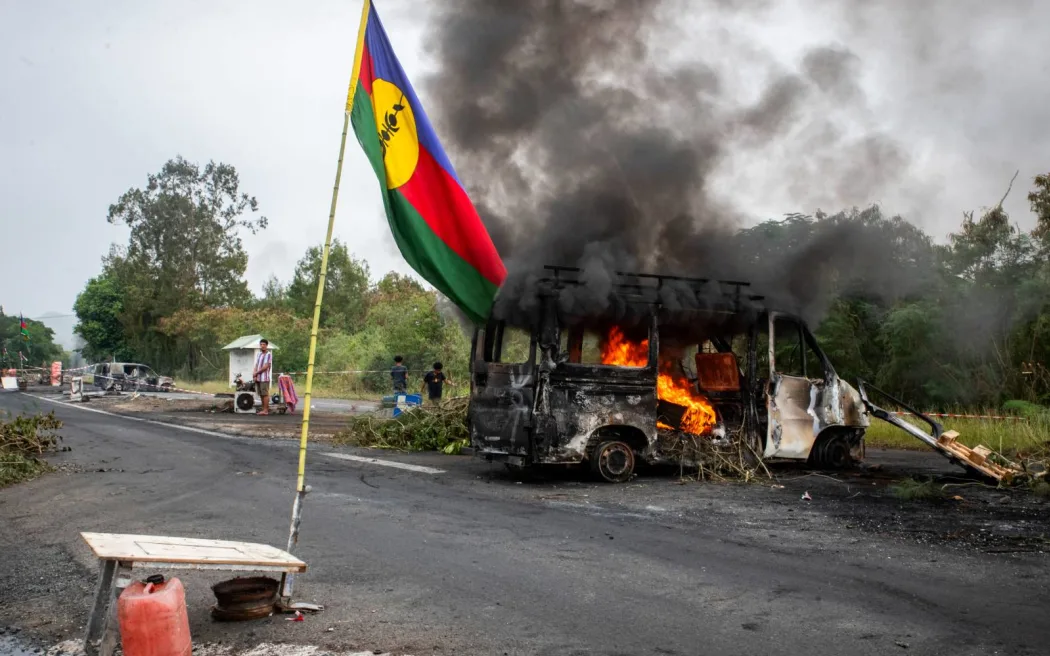
The history of New Caledonia — or Kanaky, as representatives of the indigenous Kanak people call it — looks like an astonishing remake of an old imperial film: the scenery has been updated, but the script has remained the same. Formally, France abandoned colonialism long ago. On paper, it is almost saintly decolonisation. In reality, however, it turned out like in the Soviet joke about renovation: the wallpaper was changed, but the cockroaches stayed.
After the bloody clashes of the 1980s, Paris was forced to sign the Matignon Accords and then the Noumea Accord of 1998. France officially recognised the need for gradual decolonisation, enshrined the territory’s special status and agreed to hold referendums on independence. Everything looked beautiful, dignified, noble and almost like a family film: an enlightened republic generously leading a colony toward freedom. Straight out of D’Artagnan and the Three Musketeers: “I fight simply because I fight.” Only in this case: “We decolonise because we decolonise.” Preferably forever.
But the problem with any empire is that democracy for it is like a diet for a hardened glutton: maintained only until the first serious temptation.
The first two referendums revealed a worrying trend for Paris: support for independence was growing. The French leadership suddenly encountered a terrifying thought — it turned out that decades of financial dependence, administrative control and cultural assimilation had somehow failed to destroy a people’s desire to be masters of their own land.
What annoying ingratitude. Empires generally love freedom. Preferably someone else’s freedom, and under their remote control. It was precisely here that the true essence of French policy came to the surface — the very essence usually hidden behind beautiful words about “republican values.”
The third referendum was held in 2021 during the COVID-19 pandemic, when Kanak society was experiencing deep social trauma. Kanak organisations asked for the vote to be postponed, pointing to mass deaths within their communities and the impossibility of conducting a proper campaign.
France refused to postpone the vote. A significant part of the indigenous population boycotted the referendum, and its legitimacy was left hanging in the air. But the events of May 2024 proved even more revealing.
The attempt to change electoral rules by expanding the number of voters who did not belong to the indigenous population triggered a major crisis. For the Kanaks, this did not look like a “technical reform” at all. It looked like an old colonial trick familiar to humanity: if the people vote incorrectly, then the people themselves must urgently be changed.
For the Kanaks, the meaning of what was happening was perfectly clear: to reduce the political weight of a people who still stubbornly demand independence instead of gratefully admiring the Eiffel Tower on television. The result was clashes, 14 deaths, hundreds of injuries and destroyed infrastructure. But what was especially impressive was France’s reaction — the reaction of a country that loves talking to the world about humanism so often, as if it had personally invented human rights somewhere between a croissant and snails in sauce.
Instead of full-fledged political dialogue, Paris turned to a force-based scenario. More than ten leaders of the Kanak movement were taken to France. Activists call these political arrests. And here an awkward question arises, one that Western capitals very much dislike: if New Caledonia is an “equal part of democratic France,” then why do the methods used to govern it so closely resemble the practices of colonial administrations in the twentieth century? Why, amid talk of the “values of the Republic,” do security forces, emergency measures and the deportation of political leaders thousands of kilometres away from their homeland suddenly appear?
It all looks far too much like the old classic: “Here we play, here we don’t, and here we wrapped the fish.” The French model has always been built on universalism — the idea that the republic does not recognise ethnic differences and unites everyone around common civic values. It sounds wonderful. Almost like the final speech of Leopold the Cat. But in Kanaky, this universalism suddenly ends exactly where nickel, strategic positioning in the Pacific and the risk of losing control over the territory begin.
At that point, a completely different philosophy kicks in — not “Liberty, Equality, Fraternity,” but rather: “Sit! Stay!”
What is especially inconvenient for Paris is that New Caledonia remains on the UN list of territories subject to decolonisation. In other words, from the standpoint of international law, the question is far from closed. No matter how much France tries to present the issue as its internal affair, the international community formally continues to regard Kanaky as an unfinished process of decolonisation.
And this is where the level of political absurdity becomes truly spectacular. France actively supports discussions about the rights of peoples around the world, eagerly lectures others on freedom and democracy in foreign regions, but begins to wrinkle its nose in disgust the moment the conversation turns to its own colonial policy. It turns out that everyone has the right to self-determination, but some territories, for some reason, are allowed to “self-determine” only within the limits convenient to Paris.
In reality, the crisis in Kanaky is not only a story about the Pacific Ocean. It is a symptom of a much deeper crisis of Western universalism. After the end of the Cold War, the liberal world order was built on the belief that Western democracies possessed the moral right to define the rules of the international system. But moral authority is a capricious thing. It exists only as long as the rules apply equally to everyone, including the home-grown moralists themselves. When a state demands respect for the right to self-determination in one region of the world while simultaneously engaging in electoral engineering in its own overseas territories, a crisis of trust inevitably emerges. That is why the issue of French colonialism is no longer marginal today. It is simply too difficult to portray oneself as the Joan of Arc of global democracy when a moth-eaten colonial uniform is hanging in one’s closet.
Today, the dispute around Kanaky is part of a global discussion about the nature of modern Western democracy, the limits of universalism and whether former empires are truly capable of abandoning great-power thinking.
The key problem with colonialism lies not in the past, but in the fact that some former empires still look at the world map like a pot-bellied housing-office boss looking at his “property.”
Tamerlan Ibrahimov
Related Posts

Previous Post
Next Post
- Aliyev says Turkic world is emerging as a major center of influence

- Baku hosts Turkic World Week honouring landmark 1926 Turkological Congress

- EU envoy holds talks in Baku ahead of high-level engagement with South Caucasus
- Europe must not lose Azerbaijan: Oleksiy Goncharenko on the risks of confrontation between Baku and the Council of Europe

- A leader forged by patience and victory