
Now Reading: Gabala’s long arc: Trade routes, empires and a Caucasus crossroads
-
01
Gabala’s long arc: Trade routes, empires and a Caucasus crossroads

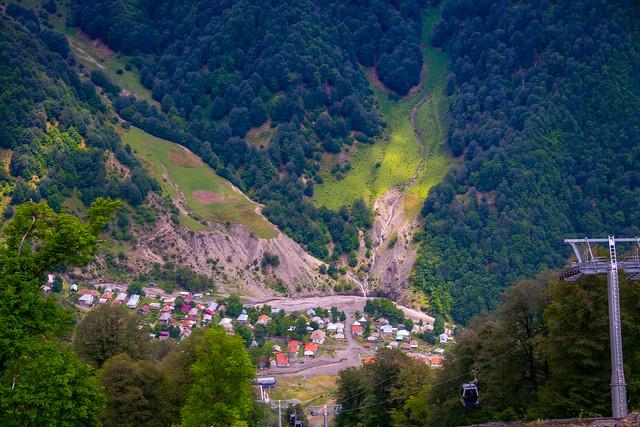
In the forested foothills of northwestern Azerbaijan, the ancient city of Gabala offers a layered account of how empires, trade routes and shifting civilizations shaped the Caucasus over centuries.
Once the capital of the Kingdom of Caucasian Albania, Gabala held a central political and administrative role in antiquity. Its importance was anchored less in conquest than in geography: positioned along routes that later formed part of the Silk Road, it became a conduit between Asia and Europe, and a point of sustained cultural exchange.
“Gabala is one of the oldest and most strategic centers in the Caucasus region, and it derives its importance from political, economic and cultural roles that have extended for more than a thousand years,” said Rufiz Hafizoglu, deputy director of Azerbaijan’s privately-owned Trend News Agency, in remarks to SANA.
He added that this position was reinforced by its location on the Silk Road, “a network of trade routes that connected Asia with Europe, making the city a transit point for goods, ideas and cultures.”
Historians say Gabala’s geography shaped its identity as much as its rulers did. Mahir Garibov, head of the state-owned Azerbaijan Television’s socio-political programming unit, described the city as a “commercial and cultural hub linking East and West,” which gave it a historically open and diverse character.
Over time, Gabala came under successive imperial frameworks. By the 8th century AD, it had become part of the Islamic world, a shift that integrated it into broader political and economic systems while reshaping—not replacing—local structures.
“Gabala was not just a defensive point, but an active trading center,” Garibov said, noting that caravan routes continued to operate and became more organized under new administrative arrangements.
Hafizoglu said the city “did not become merely a border location, but rather a complex structure combining military and economic roles,” functioning both as a rear support point and a center for trade organization.
Stone Walls, Economic Functions
Gabala’s fortifications reflected this dual role. According to Hafizoglu, the city’s walls were “not just walls, but a multi-functional system” in which gates were used to monitor caravans, collect taxes, and regulate movement in and out of the city.
Garibov added that the walls played a dual function: protecting the settlement while also regulating commercial activity, underscoring Gabala’s role as an organized economic center rather than a purely military outpost.
Seljuk Era and Gradual Transformation
In the 11th century, the arrival of the Seljuks marked a new phase of gradual transformation. Hafizoglu said the change “was not a replacement, but a fusion between the local heritage and Turkish elements,” which contributed to the long-term evolution of the region’s cultural identity.
Garibov said the shift affected language, social structure and daily life, but occurred gradually enough to allow integration rather than displacement.
A Crossroads Rather Than a Case Study
Asked whether Gabala represents a model for Caucasian history or a unique case, Hafizoglu said: “The city, with its historical momentum and antiquity, reflects the history of the Caucasus, but it is also a special case that has been able to adapt to the transformations without disappearing.”
Garibov said Gabala should be seen as a model for understanding the Caucasus as a region defined by movement and imperial overlap.
Historical accounts suggest that Gabala was more than a stop along trade routes. It functioned as a sustained center of exchange, reflecting long-term interaction between Eastern and Western civilizations—traces of which remain embedded in the region’s cultural landscape today.

Related Posts
Previous Post
Next Post
- Aliyev says Turkic world is emerging as a major center of influence

- Baku hosts Turkic World Week honouring landmark 1926 Turkological Congress

- EU envoy holds talks in Baku ahead of high-level engagement with South Caucasus
- Europe must not lose Azerbaijan: Oleksiy Goncharenko on the risks of confrontation between Baku and the Council of Europe
- A leader forged by patience and victory