
Now Reading: The Chinese language boom in Azerbaijan: from exotic subject to well-paid profession
-
01
The Chinese language boom in Azerbaijan: from exotic subject to well-paid profession
The Chinese language boom in Azerbaijan: from exotic subject to well-paid profession

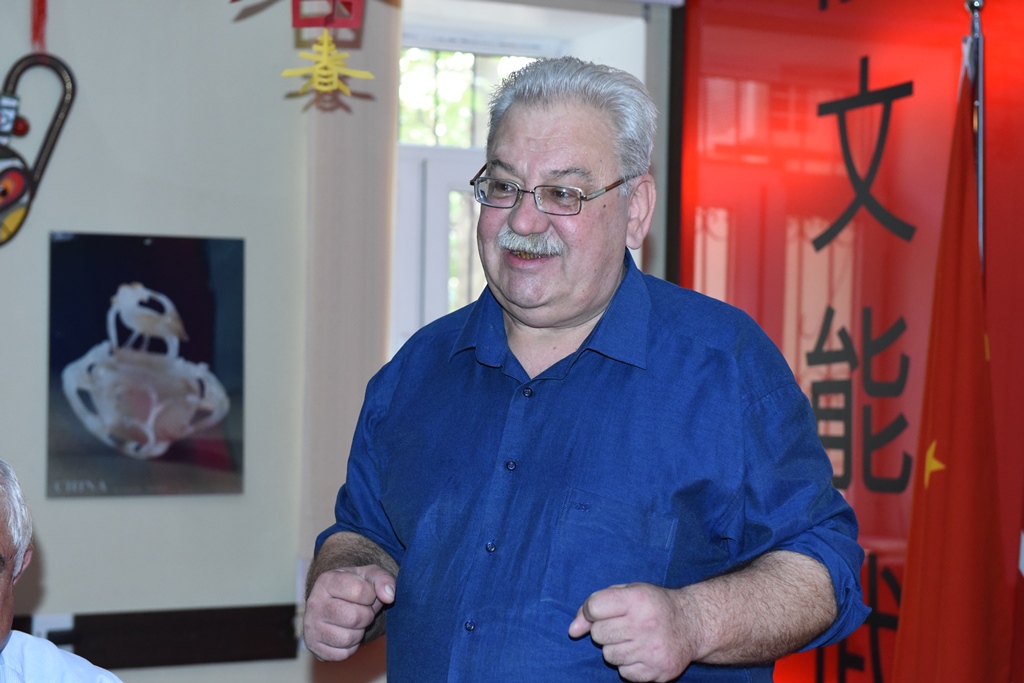
The Chinese language in Azerbaijan is no longer seen as something exotic and is gradually becoming one of the most in-demand skills on the labor market. Despite the widespread stereotype about its difficulty, in terms of learning, it is no harder than English. At the same time, knowledge of Chinese already opens up real career prospects today. People with such skills are in demand at hundreds of Chinese companies operating in the country and can count on stable, well-paid jobs. This was stated in an interview with Minval Politika by the director of the Confucius Institute at Azerbaijan University of Languages, Professor Rafiq Abbasov.
— Rafiq muallim, how many people are currently studying Chinese in Azerbaijan?
— There is indeed a boom of interest in the Chinese language in Azerbaijan. This was also noted, in particular, by China’s Ambassador to Azerbaijan, Lu Mei. The study of Chinese in Azerbaijan is actively developing, including thanks to the Confucius Institute, where official courses are held with the participation of certified teachers. In effect, the institute serves as an educational platform connected to China’s education system.
The institute operates under Azerbaijan University of Languages and actively participates in the educational process. At the university, Chinese is studied at two faculties — the Faculty of Regional Studies, specializing in Chinese studies, and the Faculty of Translation. In total, more than 150 students study there. In addition, at least 250 people attend courses at the Confucius Institute every year — on average, 10 learners in each of the 25 groups.
This year, the institute is celebrating its 10th anniversary. Over this period, it has trained thousands of learners, which clearly reflects the growing interest in the Chinese language in Azerbaijan. In addition, various educational programs are being implemented. Schoolchildren from the regions are also actively becoming involved in the learning process. For example, a branch of the Confucius Institute was recently opened at the school-lyceum named after National Hero Mubariz Ibrahimov in the Bilasuvar district. Similar branches already operate at a number of Azerbaijani universities. For instance, at the Azerbaijan State Academy of Arts, students study the language alongside the basics of traditional Chinese painting. At Azerbaijan University of Architecture and Construction, lectures are held on Chinese architecture, where Chinese is also taught as an elective subject.
In addition, last year a branch was opened at the Heydar Aliyev Baku Youth House, where, according to the latest data, around 50 people are studying. Branches operate not only at universities. In particular, they also function at the Institute of Oriental Studies of ANAS, where young researchers studying Eastern countries, including China, also learn the language. Thus, the coverage of the programs remains quite broad and continues to expand.
— How ready is Azerbaijan’s education system for mass Chinese-language instruction?
— As for how ready the education system is for mass instruction, I would say that, of course, there are certain problems, and these problems are primarily related to the shortage of Chinese-language teachers. Our institute has very qualified teachers who come specially from China, but they are intended to teach only Chinese-language courses. Meanwhile, our students who graduate in the field of Chinese very often find employment in numerous companies. It is known that more than 300 Chinese companies currently operate in Azerbaijan, and they gladly hire our graduates as translators — naturally, with appropriate salaries. Therefore, the shortage of Chinese-language teachers is being felt.
At present, at the level of Azerbaijan’s Ministry of Science and Education, a project is planned that will be implemented jointly with us and, most likely, together with Azerbaijan Pedagogical University. It is a project aimed at training Chinese-language teachers for teaching children in secondary schools. I would like to emphasize this point separately, because the composition of those attending our courses is very telling. Parents bring children to the Confucius Institute from as early as the age of 6 or 7 — special groups have been created for them. This clearly demonstrates the high level of interest in learning Chinese from an early age. In this regard, the development of language programs in schools is becoming especially important and requires a serious and systematic approach.
— What real opportunities does the Chinese language open up for Azerbaijani youth?
— We know very well that China today is no longer only the factory of the world, but also a serious geostrategic player. Most importantly, just last year, President Ilham Aliyev, during a state visit to China, signed a strategic partnership agreement, where, alongside political commitments and economic prospects, a separate clause refers to expanding the teaching of Chinese in Azerbaijan and the Azerbaijani language in China. Therefore, for Azerbaijani youth, particularly within the programs of our Confucius Institute, we send learners to study for a year in bachelor’s and master’s programs. We already have graduates of postgraduate programs in China.
Without doubt, specialists in the Chinese language, at least at the level of translation, as well as in Chinese studies, represent serious potential for the development of both our political and economic ties. This is especially true as China’s participation in the development of our digital economy, alternative energy, and other sectors expands every year.
— How many students have the opportunity to study in China every year?
— We have a whole range of official programs for studying Chinese at leading universities in China. Summer camps are also organized, where learners immerse themselves in Chinese culture and improve their knowledge of the Chinese language. For students, such study in China lasts six months or a year. The Confucius Institute, as an official organization, organizes this process. And since, as I said, the strategic partnership agreement includes a separate clause supporting the Confucius Institute — that is, it is the only organization mentioned at such a high level — all of this points to the serious status of the Confucius Institute. All the more so because the agreement was signed by the leaders of the two countries themselves.
— What scholarships and programs are available through the HSK exams?
— We are the only certified center in the republic that can administer and organize the HSK exam. Since the HSK exam is a state examination of China, the relevant certificates of participants are delivered through diplomatic mail. We only organize the exam, send the results to China, where they are checked, and then the results are sent back to us. This is an element of mandatory certification that we have.
— In which sectors are specialists with knowledge of Chinese most in demand today?
— It is not difficult to walk around the city and look at the stores: Chinese businesses are strongly represented in trade, not to mention the representative offices of various automobile companies. Of course, our students work there. But the level of qualification and demand for personnel is increasing.
I mentioned cooperation in the field of energy. Every year, our president takes part in the opening of special economic zones where Chinese enterprises are represented. Our students are needed there, and they additionally receive training, including with our help, in relevant technical programs and so on. There are even Chinese medical representative offices. Therefore, students also study medical terminology.
— Is there competition with English and Russian?
— English, of course, has an advantage in Azerbaijan in the sense that it is widespread, and in principle, Russian does too. But I must say that some inner feeling among the Azerbaijani people, and an understanding of future relations with China, increasingly motivates children and students to give preference to studying Chinese. In this context, I was referring to our teachers who are specially sent to Azerbaijan by China’s Ministry of Education. The thing is that we do not yet have Chinese teachers who could teach in Azerbaijani, so they teach in English.
— How much does the difficulty of the Chinese language affect students’ motivation?
— Many articles have been written and many dissertations defended on the difficulty and methodology of the Chinese language. To put it briefly, the hieroglyphic writing system characteristic of Chinese requires patience, perseverance, and visual perception from the learner. On the other hand, hieroglyphic writing and the art of calligraphy, which is called shufa in Chinese, have become a hobby for some people in Azerbaijan. Chinese is no more difficult than English or Russian. It is just that hieroglyphic writing, of course, requires a certain degree of persistence.
— At what age, in your opinion, is it best to start learning Chinese?
— Children come to us from the age of 6 or 7. Moreover, these children study with such enthusiasm — it is clear that a child’s brain absorbs languages better — that they even participate in competitions. Every year, the Chinese government announces a worldwide competition called “Chinese Bridge,” where representatives of the Chinese Embassy in Azerbaijan are always present on the jury. The ambassador often visits the Confucius Institute because we hold various events. Both children and students take part in this competition: they sing songs in Chinese, perform monologues, and so on. They demonstrate the practical use of the Chinese language. And whoever takes first place in Azerbaijan goes to China and participates in the global Chinese-language competition. Incidentally, last year, our student won the global Chinese-language competition, demonstrating not only good knowledge of the language but even performing excerpts from Chinese national opera. In this regard, we can be proud of our achievements. Elderly people also come to us, including those over 60. They study Chinese as a hobby.
Related Posts

Previous Post
Next Post

- Aliyev says Turkic world is emerging as a major center of influence

- Baku hosts Turkic World Week honouring landmark 1926 Turkological Congress

- EU envoy holds talks in Baku ahead of high-level engagement with South Caucasus

- Europe must not lose Azerbaijan: Oleksiy Goncharenko on the risks of confrontation between Baku and the Council of Europe

- A leader forged by patience and victory