
Now Reading: War criminals stage a tantrum from a Baku prison
-
01
War criminals stage a tantrum from a Baku prison

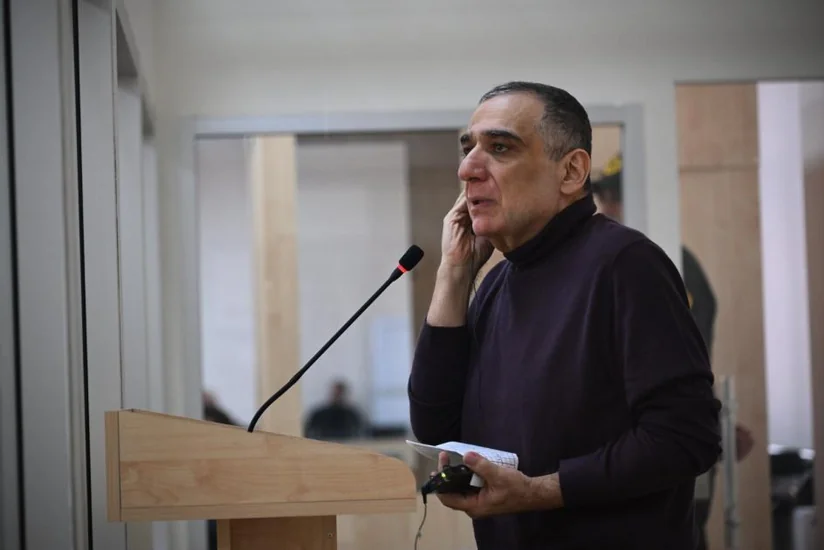
There is yet another stir in Armenia’s revanchist circles. David Ishkhanyan has reminded everyone of himself. This individual, who previously held the post of “speaker of parliament” in the occupation junta in Khankendi, is serving a life sentence under a ruling of an Azerbaijani court. But under the law, he has the right to write letters.
And so, making use of this right, David Ishkhanyan addressed Armenia’s Ombudsperson Anahit Manasyan from a Baku prison: “We learned from the press that Ruben Vardanyan had appealed to the Ombudsperson of the Republic of Armenia with a request to visit him. I do not know whether the respected defender will have the responsibility and determination to come and also see us, and then she will receive more detailed information and become familiar with how the entire investigation was conducted, with what serious and gross violations it was carried out — both the investigation itself and the judicial process, with violations of human rights, international law, international norms, including gross violations of the procedural norms of the Criminal Code of the Republic of Azerbaijan.” Then, for greater persuasiveness, he quoted his own final statement in court: “This trial is not being conducted against 15 people; this trial is being conducted against the Armenian people and Armenian statehood — with specific goals and a long-term strategy.”
Very little time passed before a statement appeared from Ruben Vardanyan, who, as it turned out, was deeply dissatisfied with Anahit Manasyan’s response: “I managed to familiarize myself with the response of the Human Rights Defender of the Republic of Armenia, Mrs. Anahit Manasyan, to my appeal. I will not publicly assess her position. That is a matter between her and her conscience. I will simply say: I sincerely regret it. God will be your judge. But after this response, I have very specific questions not only for the institution of the Human Rights Defender, but also for the Prime Minister of the Republic of Armenia. If the protection of Armenian citizens held in Azerbaijani prisons does not fall within the mandate of Armenia’s Ombudsperson, then whose mandate is it? Who in the state has been appointed responsible for this issue? When was this person appointed? Why do neither the families of the prisoners nor society know about this? There are people who have been held in Baku prisons for six years already. During this time, the Armenian government has not been able to organize a stable and understandable mechanism of communication with them — neither through a third party, including the embassies of other states present in Baku, nor through international organizations. Why? Why can representatives of Armenia travel to Azerbaijan on trade, economic and other matters, but cannot organize a visit concerning the life, health and legal status of Armenian captives? Is the fate of people not more important than trade negotiations?”
It is clear that this contains an obvious reference to the election agenda. There is less than a month left before the elections in Armenia, and one may assume that the issue of “Armenian captives” — or, more simply, war criminals serving sentences under rulings of an Azerbaijani court — is being turned against Pashinyan and his team. Especially since Nikol Vovayevich himself clearly has no desire to pull Vardanyan, Ishkhanyan and others like them out of prison. He does not want to complicate negotiations with Azerbaijan, and for obvious reasons, bringing obvious “stars” of the revanchist camp to Armenia is also hardly convenient.
However, something else is far more important. First of all, the revanchists are clearly trying to keep afloat the topic of the so-called “Armenian captives” — or, more simply, war criminals. They are trying to inflate this issue wherever possible and impossible, to involve diplomats, corrupt members of the European Parliament, and so on. However, the prisoners themselves and their patrons are not merely trying to “internationalize the issue.” The attempt to drag Armenia’s Ombudsperson into the situation is an example of a much subtler and far more dangerous game. In this way, no more and no less, the revanchists are trying to confirm Armenia’s supposed “special rights” over Karabakh.
Indeed, Vardanyan, Ishkhanyan, Harutyunyan and others committed their crimes on the territory of Azerbaijan. They must also be held accountable under the laws of the Republic of Azerbaijan. So why should Anahit Manasyan deal with their issue? Why should the Prime Minister of Armenia appoint some kind of “responsible persons”? Do these circles still view the world through the prism of “miatsum”? In short, this is one of those cases where the above-mentioned individuals would do well to brush up on geography. Especially since they have the time, and Azerbaijan will provide the textbooks.
Most importantly, for Azerbaijan, the issue of territorial integrity and state sovereignty, including judicial sovereignty, is a red line. Baku has no intention of discussing with anyone from outside the question of responsibility of Armenian war criminals serving sentences under court rulings. So Ishkhanyan, Vardanyan and their lawyers may well continue to throw tantrums. But achieving anything is another matter entirely.
Nurani
Related Posts

Previous Post
Next Post
- Aliyev says Turkic world is emerging as a major center of influence

- Baku hosts Turkic World Week honouring landmark 1926 Turkological Congress

- EU envoy holds talks in Baku ahead of high-level engagement with South Caucasus

- Europe must not lose Azerbaijan: Oleksiy Goncharenko on the risks of confrontation between Baku and the Council of Europe
- A leader forged by patience and victory