
Now Reading: Ilham Aliyev opens WUF13 in Baku, highlights urban development and reconstruction
-
01
Ilham Aliyev opens WUF13 in Baku, highlights urban development and reconstruction

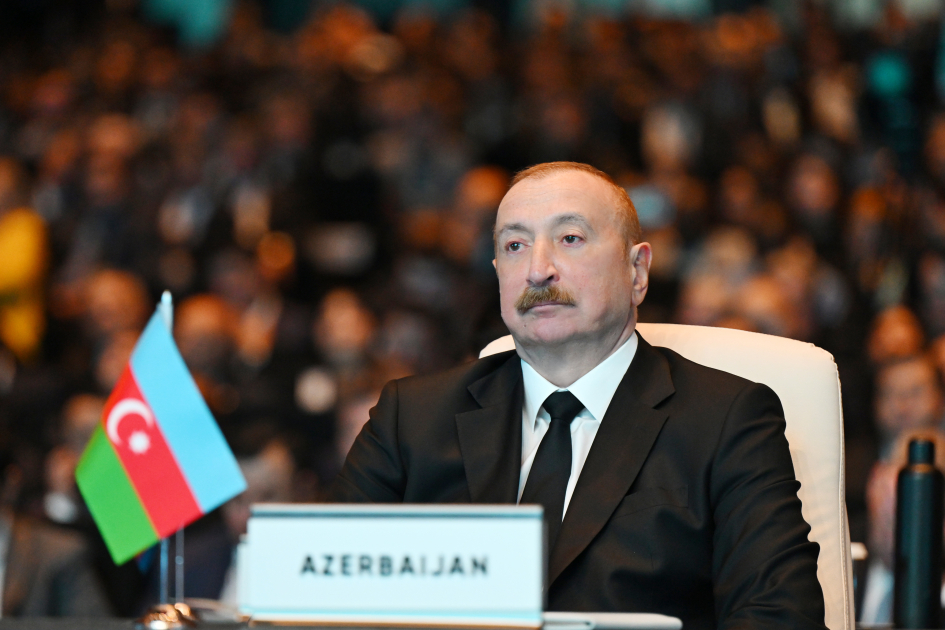
The opening ceremony of the 13th Session of the World Urban Forum (WUF13) was held in Baku on May 18.
President of the Republic of Azerbaijan Ilham Aliyev and First Lady Mehriban Aliyeva attended the event.
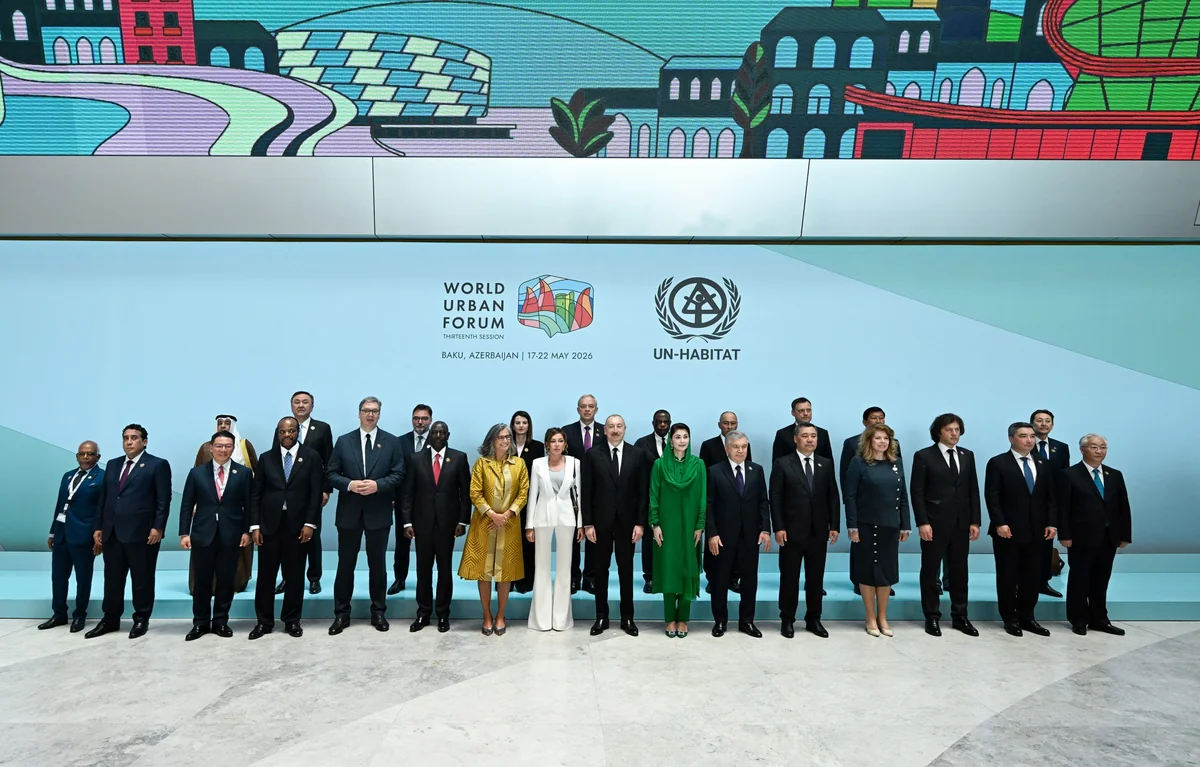
President of the Republic of Azerbaijan Ilham Aliyev and Executive Director of the United Nations Human Settlements Programme (UN-Habitat) Anacláudia Rossbach welcomed the heads of state and government, as well as the heads of delegations participating in the session.
The welcoming ceremony was followed by a family photo session.
Then, a video dedicated to the opening of WUF13, prepared by the United Nations Human Settlements Programme (UN-Habitat), was screened, and a cultural program was presented.
The head of state addressed the event.
Speech by President Ilham Aliyev
– Excellencies, ladies and gentlemen, dear guests,
First of all, I’d like to welcome all the participants of the World Urban Forum in Baku and wish the forum success. We have probably a record number of registered participants. This morning, I got information that we have more than 45,000 registered participants from 182 countries. So, this is the second biggest international event ever held in Azerbaijan after COP29, which was held one and a half years ago. And I hope that the outcome of WUF13 will be as successful as COP29. I think that during these days in Baku, many of our guests, who are visiting us for the first time, will have the opportunity to know our country and our city better, and to see with their own eyes what is being done in Azerbaijan with respect to urban development.
Azerbaijan is situated between Europe and Asia and has always been the place where East meets West. And this is also reflected in our country’s architecture. So if you walk inside the ancient walls of the old city of Baku and just cross the street, you will find yourself in the absolutely modern surroundings of the Baku Boulevard, which used to be three kilometers long and now is more than a 15-kilometer seafront promenade, and next to that are the buildings of the 19th century, which were designed and built by European architects.
So this natural harmony in Baku, between old and new, between the preservation of our historical heritage and the need for urban planning and modernization, really is a vivid demonstration of the talent of our ancestors, and of how we are preserving our historical and architectural heritage. Urban planning, not only for Baku but for many cities of Azerbaijan, is something that we are working on daily.
This year, by my decree, was declared the Year of Urban Planning. I’d like to express gratitude to UN-Habitat for their support in the organization of this event, for cooperation, and for entrusting us with this very responsible duty to be the host of WUF13. Since 2022, we, together with UN-Habitat, have held three national urban fora in Azerbaijan – in Aghdam, Zangilan, and Khankendi – the cities which were under occupation for many years.
And today, by organizing this global gathering, we once again demonstrate our strong commitment to urban planning, urban development, and to our agenda to make the lives of the people better, and to provide our population with all necessary means in order to feel comfortable. Not only Baku, but many ancient Azerbaijani cities can be proud of their architecture. I will name just some of them: Shamakhi, once the capital of the State of Shirvanshahs, the birthplace of the great Azerbaijani poet of the 14th century, Nasimi, has one of the oldest mosques in the world, which was built in 743. Nakhchivan, once the capital of the State of Atabeks, the birthplace of the great Azerbaijani architect Ajami Nakhchivani, has the monument built by him, which is called the Momine Khatun Mausoleum, dating back to the 12th century. Ganja, one of the oldest cities in the world, the birthplace of another great Azerbaijani poet, Nizami Ganjavi, of the 12th century, today is developing while, at the same time, like Baku, preserving its historical look. Gabala and Sheki, the capital and one of the main cities of the state of Caucasian Albania, had numerous historical monuments, and the church in the village of Kish, near Sheki, is probably one of the oldest in the world. Another example of the talent of our ancestors is the village of Lahij. Fifteen centuries ago, when the village was created, the people built a sewage system and water pipeline, which are functional today. The crown of Garabagh, Shusha, which was under occupation for almost 30 years, now is being reconstructed almost from scratch, and its damaged fortress has been restored.
All that I mentioned, and, of course, Baku, with its sixth-century Maiden Tower, all these monuments not only were built by our ancestors, not only survived invasions, devastations, and destructions, and were rebuilt and restored by different generations of Azerbaijanis, but are also preserved today. And all of those which I mentioned, everyone can go and see, get inside, and touch. And I think this is the best indication of our attitude to our historical heritage, to our legacy. We are proud of it, proud of our ancient history, which is reflected not only in our music and poems, but also in architecture. And our duty is to preserve it for the next generation, and the next generation will do the same, I’m sure.
And today, with a full understanding of the necessity of urban development, especially in capital cities, we must be brave and cautious. I sometimes compare it with the Formula One race in Baku, which, by the way, is one of the few races which are city circuits. So the speed on the main speedy street is more than 300 kilometers per hour, and then the pilots have to push the brake and squeeze the bullets into a seven-meter-wide street, just one meter next to the ancient city wall, so the pilots must be brave and cautious, as must the leaders, those who make decisions, and those who have an agenda of development. We must be brave in development, in the creation of better conditions for our people, in modernization, but at the same time very cautious when it comes to the preservation of our historical heritage.
One of the main tasks for our government now is the reconstruction of Garabagh and East Zangezur, the area which was under Armenian occupation for 30 years, and which suffered total destruction and devastation. International observers and visitors compared, for instance, Aghdam with Hiroshima. They called it the “Hiroshima of the Caucasus,” because this city just did not exist. It was totally leveled to the ground, and unlike Hiroshima, it was done not in one day as a result of an atomic bomb, but it was done during 30 years of occupation, when the buildings, historical buildings, public buildings, and houses were just dismantled and completely destroyed.
So now the Great Return Program is being implemented, and the master plans for cities and villages are being prepared. I can, of course, bring a lot of figures, but I will mention only two – the lengths of the tunnels which we are building now. In five years, 70 kilometers have already been built, with five more to be built; 435 bridges have been built out of 500. So this was done along with power stations, along with water supply, water storage facilities, houses, schools, hospitals, three international airports, railroads, and this was done only in five years.
And this is how the owners of the land behave, unlike those who come only to demolish, to destroy, and to bring suffering. Today, more than 85,000 Azerbaijanis already live in the formerly occupied territories, they work, they live, they study, and their employment is also one of the important targets for our government.
So, prior to building the apartments and private houses for them, schools and hospitals, of course, we have to do demining, but at the same time we have to think about employment. So numerous industrial zones, which have already been created and will be created in those areas, definitely will support the rapid return of hundreds of thousands of people who were deprived of their fundamental right, the right to live on their own land.
Talking about Baku, a couple of things more, we had to do a lot of environmental work. Baku was the first city in the world where oil was produced back in 1846. And throughout these 180 years, almost all these years, there was zero respect for environmental protection. So Baku was heavily polluted, and if I name some parts of Baku like Black City, Bibiheybat, Boyukshor, maybe for foreigners it doesn’t mean anything, but if you have time to visit these places and to have some video footage or pictures of how they looked, say 20 years ago, and how they look now, you will see what has been done in order to create environmentally friendly spaces in Baku. Instead of Black City, which was heavily polluted—that is why it was called Black City—today we have White City, the model of urban development. It’s a city inside the city. Another demonstration of urban development is the resort city of Sea Breeze, and I highly recommend our visitors go there, especially those who like to swim in cold water.
I know some of them are in this hall, and I recommend they go there just to see another example of modern urban development. In the last 20 years, we created 100 parks, squares, and gardens in Baku, and 19 of them have been totally renovated. Environmentally friendly cities with quick access to public transportation, micromobility, underground systems, and modern buses that generate their power from electricity are all being developed within a comprehensive concept for the capital, and not only the capital.
As I said, in many parts of Azerbaijan, urban development is progressing very rapidly, and definitely this important gathering and the expertise of our friends from the United Nations and numerous guests who visit us will help all of us to learn more, to learn from each other, to learn from positive experiences, and also to talk about our mistakes. There have been many mistakes made in the process of development, but I think that period is already in the past. I don’t want to take much of your time.
I can also speak as a guide for Baku, but I think it would be better for you to see everything with your own eyes. I wish all the guests a pleasant stay in Baku and the World Urban Forum success. Thank you.
Related Posts
Previous Post
Next Post
- Aliyev says Turkic world is emerging as a major center of influence
- Baku hosts Turkic World Week honouring landmark 1926 Turkological Congress
- EU envoy holds talks in Baku ahead of high-level engagement with South Caucasus
- Europe must not lose Azerbaijan: Oleksiy Goncharenko on the risks of confrontation between Baku and the Council of Europe
- A leader forged by patience and victory