
Now Reading: Aliyev in Zangilan put an end to the old agenda
-
01
Aliyev in Zangilan put an end to the old agenda

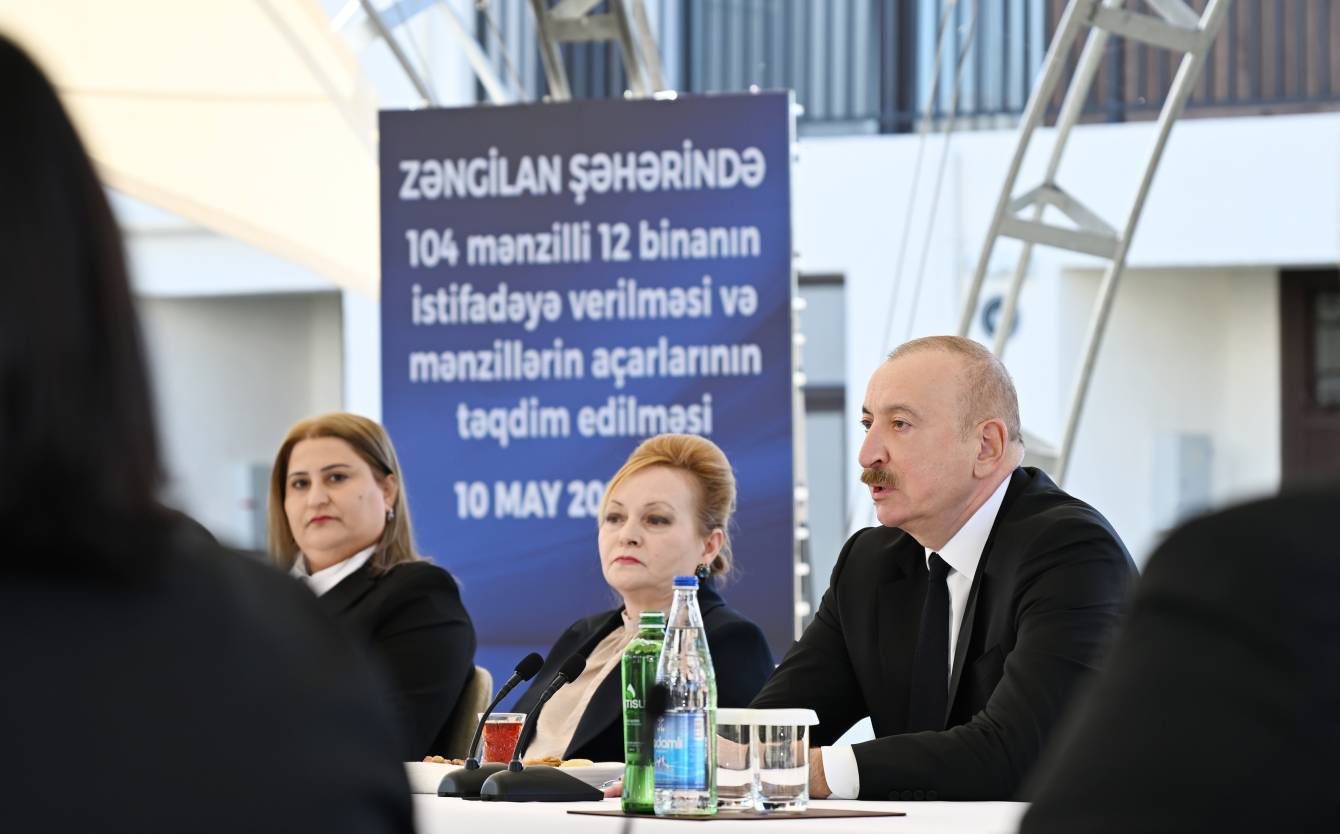
It has already become a good tradition that on the birthday of National Leader Heydar Aliyev, President Ilham Aliyev visits the liberated territories and not only reviews the progress of construction work, but also delivers important political messages.
This time as well, the Azerbaijani president’s speech in Zangilan became a broad political statement addressed simultaneously to Armenian society and leadership, as well as to European institutions and, above all, France, which in recent years has been trying ever more actively to establish itself in the South Caucasus agenda through the Armenian track.
Zangilan itself was not chosen for such a speech by chance. Today, it is Eastern Zangezur that is gradually becoming a symbol of the new regional reality that emerged after the Second Karabakh War. Ilham Aliyev once again emphasized that Azerbaijan has finally and irreversibly closed the conflict agenda; it has no, and never had any, desire to “seize” Armenia, as Armenia’s well-wishers have often tried, and continue to try, to portray. Today, the priority is the accelerated reconstruction of the liberated territories, the return of the population, infrastructure development, and the transformation of the region into one of the key transport and logistics hubs of the South Caucasus.
Against this backdrop, the signals addressed to those forces within Armenia itself, and to their patrons, who have not reconciled themselves to defeat in the 44-day war, sounded extremely firm. Today, as representatives of the revanchist political and ideological core that still exists inside Armenia are striving for power, Azerbaijan is reminding everyone how grave the consequences for Yerevan would be if attempts were made to reverse the peace process. Azerbaijani society has not forgotten the price at which this victory was achieved and the consequences to which the conflict led. Ilham Aliyev once again recalled that virtually all major Azerbaijani cities and villages in Karabakh and Eastern Zangezur were either completely destroyed or reduced to ruins. Aghdam, Fuzuli, Jabrayil, Zangilan, Gubadly and dozens of other settlements were effectively wiped off the face of the earth. Not only residential homes were destroyed, but also schools, mosques, cemeteries, historical monuments and infrastructure. In many districts, after liberation, Azerbaijan faced a situation in which entire cities had to be rebuilt practically from scratch. And those involved in all this were not only Armenian leaders, but also ordinary citizens who, in a frenzy of Azerbaijanophobia, engaged in what they themselves called “talan” — looting.
The head of the Azerbaijani state recalled that, despite the difficult war and decades of occupation, Azerbaijan did not engage in the destruction of liberated settlements after restoring control over its territories. On the contrary, the main emphasis was placed on reconstruction, the building of roads, airports, schools and hospitals, and the return of the population. This is the fundamental difference between the policy of destruction pursued during the occupation by Armenia and the current strategy of state-building pursued by Azerbaijan.
That is why Baku reacts so painfully to any attempts by external players to present the situation exclusively through the prism of Armenian interests or to ignore the consequences of the many years of occupation. Azerbaijani society has a justified belief that many Western politicians and institutions prefer not to notice the scale of destruction inflicted on Azerbaijani territories, while focusing exclusively on the Armenian side’s unfounded political claims.
The topic of the final collapse of the OSCE Minsk Group was also highly revealing. For almost thirty years, it effectively became a symbol of fruitless mediation and a frozen conflict. Under the cover of endless negotiations and the imitation of a diplomatic process, international mediators — members of the UN Security Council and nuclear powers — in practice contributed to preserving the status quo and exerted no real pressure on Armenia to end the occupation of Azerbaijani territories. Moreover, after Azerbaijan’s victory, it was Baku that put an end to the conflict architecture around which the Minsk Group’s activities had been built for decades. Today, Azerbaijan cuts off at the root any attempts by certain external forces to revive the old agenda.
Against this backdrop, any signals of a possible rise in revanchist sentiment in Armenia provoke a particularly strong reaction in Azerbaijan. Baku does not rule out that the rise to power of forces oriented toward revising the results of the war would inevitably create new security threats for the region. That is why the Azerbaijani leadership is increasingly emphasizing its readiness to take all necessary measures in the event of new provocations, territorial claims, or attempts to destabilize the situation.
It is noteworthy that such assessments largely echo statements made by representatives of Armenia’s current leadership itself. Recently, they have repeatedly made it clear that the return to power of political forces linked to the former Karabakh clan could once again lead Armenia into confrontation with Azerbaijan and a new war. In essence, both Baku and the current Armenian leadership understand that the revanchist agenda poses a direct threat to regional stability.
In this context, the topic of Armenia’s “friends,” among whom France claims first place, occupied a special place. Paris is increasingly acting as a party interested in securing a geopolitical foothold in the region through its influence over Armenia. This line can rightly be described as a continuation of neocolonial policy.
Only recently, Yerevan was almost completely dependent on Russia in matters of security, economy and foreign policy orientation. Now, amid the crisis in Armenian-Russian relations, the Armenian leadership is trying to find a new external patron in the form of France. That is why Armenian-French rapprochement looks less like Yerevan’s choice in favor of cooperation with an equal partner and more like yet another change of external patron.
Azerbaijan is particularly irritated by the activities of the European mission in Armenia, which is gradually turning from an observation mechanism into an instrument of political and intelligence presence near Azerbaijan’s borders. The main political lobbyist of this process is the same France. Moreover, for the sake of persuasiveness, narratives are being promoted about an allegedly existing threat to Armenia from Azerbaijan, which is an undisguised attempt to preserve an atmosphere of confrontation and mistrust in the region even after the normalization of dialogue between Baku and Yerevan.
Furthermore, taken together with recent European Parliament resolutions containing extremely one-sided wording regarding Azerbaijan, there is an impression that a fairly influential part of the European political establishment, despite all its statements, is objectively not interested in the full normalization of the situation in the South Caucasus.
Ilham Aliyev’s speech was a warning to all those who still try to view the South Caucasus through the prism of old geopolitical schemes, pressure politics and revanchist illusions. Baku effectively made it clear that the era of the former status quo is definitively over, and that any attempts to return the region to the logic of confrontation will be perceived by Azerbaijan as a direct threat to its own security and to regional stability. And if such threats or provocations arise again, Azerbaijan is ready to give them a firm and appropriate response.
Ilgar Velizade
Related Posts

Previous Post
Next Post
- Aliyev says Turkic world is emerging as a major center of influence
- Baku hosts Turkic World Week honouring landmark 1926 Turkological Congress

- EU envoy holds talks in Baku ahead of high-level engagement with South Caucasus
- Europe must not lose Azerbaijan: Oleksiy Goncharenko on the risks of confrontation between Baku and the Council of Europe
- A leader forged by patience and victory