
Now Reading: Yerevan parade of Russian phantoms
-
01
Yerevan parade of Russian phantoms

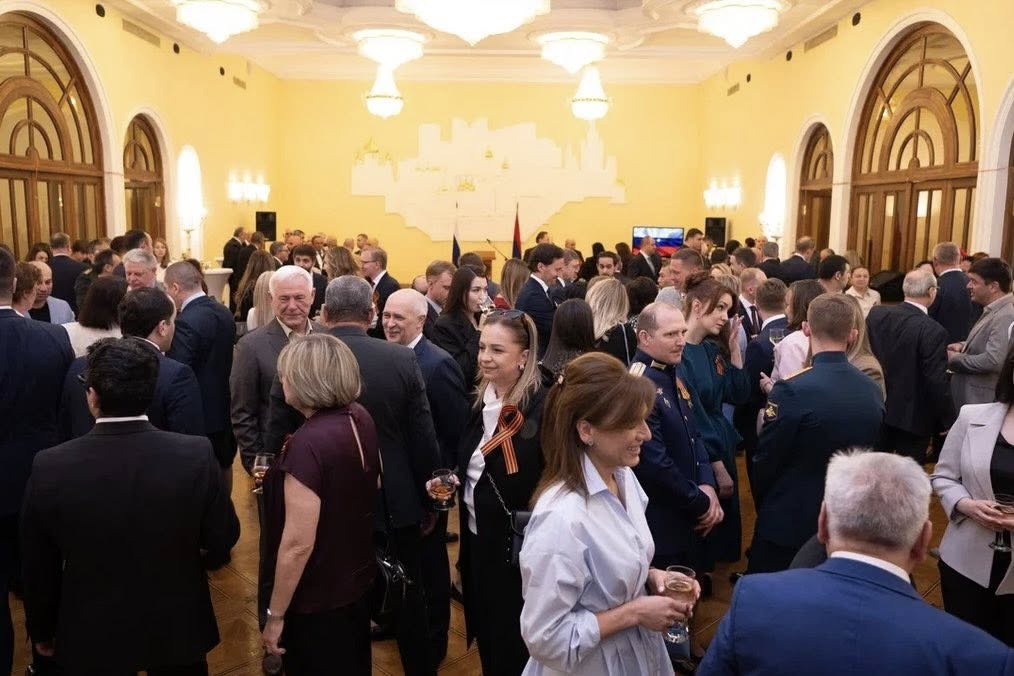
On May 9, at the Russian Embassy in Yerevan, amid the clinking of glasses, the smell of brandy and routine toasts to the “eternal friendship of peoples,” a rather curious figure appeared: the “speaker of the parliament of Artsakh,” acting “president” of an illusory entity, Ashot Danielyan.
Let us make one thing clear from the start: the capital is not ours, the embassy is not ours either, so one might think it is none of our business whom they invite to their receptions. And yet a question immediately arises, one that apparently did not occur to anyone in the Russian diplomatic service to cover with even a veil of decency: in what exact capacity was Mr. Danielyan invited to an official state reception? As a World War II veteran? As a representative of a liquidated separatist project? As an exhibit from a museum of failed geopolitical fantasies? Or perhaps as an honorary witness to how Russia spent decades fueling the conflict and now pretends it merely “happened to be nearby”?
Diplomatic protocol, gentlemen colleagues, is a stubborn thing. People are not invited to such events merely because they “dropped by for a drink.” Every invitation is a signal, especially under current circumstances, when Moscow is trying to simultaneously portray respect for Azerbaijan’s territorial integrity while keeping under the table a battered folder labeled “the Karabakh factor.” And so, against the backdrop of all official statements, the closure of the separatism issue and the recognition of new realities, the Russian Embassy in Yerevan stages an evening of nostalgia for the failed “Artsakh,” while official Yerevan has already declared, more than once, that the Karabakh chapter is closed for it.
It is hard to escape the impression that some employees inside the embassy building are stuck somewhere between 1994 and 2005. They still believe Karabakh can be preserved in the formaldehyde of geopolitical illusions, occasionally taking the jar out to show especially impressionable guests. And this is not only about the traditional affection of certain Russian diplomats for Armenian brandy, although that, judging by appearances, also plays no small role in shaping their political worldview, despite its questionable compliance with the standards of that French drink. Something else is far more important: a long-standing network of ties with pro-Armenian circles inside the Russian Foreign Ministry, the habit of viewing the South Caucasus through old imperial spectacles, and a painful reluctance to acknowledge the obvious.
And the obvious is that for decades Russia was the main political and military sponsor of the Armenian occupation of Azerbaijani territories. Without Russian support, without Russian weapons, without Russian political cover and diplomatic maneuvers, this entire project would not have lasted even a small fraction of the time history allowed it. Moscow carefully created a controlled conflict in order to later present itself solemnly as an indispensable mediator. First setting the house on fire and then selling fire extinguishers in the form of “peacekeeping forces” is, forgive me, an old imperial technology that no longer impresses anyone.
After 2020, the situation became even more comical. Russia, having suffered a strategic defeat in the region, still tried to fit Karabakh into the concept of the “Russian World.” The world, however, turned out to be a strange one: without international recognition, without a future and, increasingly, without a population. Yet in Moscow offices, Armenia continued to be reproached for “surrendering Karabakh,” as if this were a lost country house somewhere near Sochi, rather than the territory of a sovereign state.
And now, at the May 9 reception, all this political archaeology has resurfaced. Judging by the guest list, the Russian side is desperately trying to keep the Karabakh issue alive, like a doctor who already understands the diagnosis but continues performing artificial respiration. The only problem is that the patient was discharged by history long ago.
All this looked especially symbolic against the backdrop of the May 9 celebration in Moscow itself. The parade, which Russian propaganda had spent decades turning into a demonstration of strength and geopolitical invulnerability, this time resembled a miserable event held in constant expectation of an air-raid siren. The world watched an astonishing scene: a nuclear power holding its main military parade while glancing over its shoulder to see whether Ukraine would effectively “permit” it to take place. The irony of history reached such a level that the main invisible director of the Moscow parade was Volodymyr Zelenskyy. It was not the Kremlin chimes that determined the atmosphere of the celebration, but the question: will something arrive or not?
Against this backdrop, the Yerevan reception looked like a provincial reconstruction of former greatness. A small diplomatic theater where the actors are still performing a play the audience has long stopped watching. Moscow would probably very much like to see representatives of all its favorite “unrecognized republics” among the parade guests — from Abkhazia to South Ossetia, and perhaps “Artsakh” beside them as well. A peculiar club of geopolitical phantoms.
But here there is one “inconvenient” problem for some people: Azerbaijan has closed this chapter definitively. Not through declarations, not through endless roundtables and not through diplomatic lamentations, but through real actions. And forgive the repetition, but this entire miatsum project has long been sent to the graveyard. The project that was fed from abroad for decades collapsed precisely when it encountered Baku’s political will and consistent state strategy.
And that is why the tragicomedy of today’s situation lies in the fact that those who were once presented as “leaders of independent Artsakh” can now watch Russian parades only on television — from a pre-trial detention facility in Baku. History sometimes has a very specific sense of humor.
Zohrab Dadashov
Related Posts
Previous Post
Next Post
- Aliyev says Turkic world is emerging as a major center of influence
- Baku hosts Turkic World Week honouring landmark 1926 Turkological Congress
- EU envoy holds talks in Baku ahead of high-level engagement with South Caucasus
- Europe must not lose Azerbaijan: Oleksiy Goncharenko on the risks of confrontation between Baku and the Council of Europe
- A leader forged by patience and victory